Cosmetics Store

Essential oils

Lemon Oil

Lemon Oil: 5 Uplifting Benefits for Skin & Face, How to Use & Sun Safety

Written by the Amaly team. Sources are linked in the article. Last updated 15 November 2026. Key takeaways Lemon oil has a bright, fresh, uplifting scent and can give skin a fresher, brighter look. Cold-pressed oil reacts with sunlight. On skin, use it in the evening and keep that area out of the sun for 12-18 hours. This oil does not lighten skin or remove dark spots. Used before sun, it can actually cause dark marks. Pure lemon essential oil must be diluted. Cold-pressed lemon should stay at 2% or less on skin. For scent, the oil is one of the easiest oils to enjoy in a diffuser. Lemon oil is used mainly for its bright, fresh scent and to give skin a fresher look. It is also one of the oils that needs the most care, because many lemon oils react with sunlight. This guide covers what lemon oil is, its real benefits, how to use it on skin and face safely, in a diffuser and around the home, its side effects, and how to tell a real one. What is lemon oil? Lemon essential oil comes from the peel of the lemon fruit, Citrus limon. It is made in two ways, and the difference matters: Cold-pressed lemon oil: the peel is pressed to release the oil. It smells closest to fresh lemons, but it contains natural compounds that can make skin react badly to sunlight. This is called photosensitivity. Steam-distilled lemon oil: a lighter smell, and much less likely to react with the sun. “Lemon oil” can also mean a ready-to-use oil (a small amount of lemon essential oil in a carrier oil) or a lemon-scented oil. Always check the label. Lemon oil benefits: what it really does What is lemon oil used for? These are the lemon essential oil benefits that are honest to promise: A fresh, uplifting scent: one of the most cheerful oils for the home and for a morning mood. A fresher, brighter look: in an evening routine, it can give skin a fresher look. A refreshing massage: mixed with a carrier oil, in the evening. A clean-smelling home: in a diffuser or in a water spray for cleaning. A great blending oil: lemon brightens floral oils like rose and lavender. Lemon oil and the sun: the most important rule Cold-pressed citrus oils, including lemon, can cause redness, burning or dark marks on skin that goes into the sun after use. So: Use the oil on skin only in the evening. Keep that skin out of the sun and tanning beds for 12-18 hours. Keep cold-pressed lemon at 2% or less on skin (no more than 2 drops in 5 ml of carrier oil). If the label does not say “steam-distilled”, treat it as sun-sensitive. Keep using your normal sunscreen during the day. Lemon oil for skin Patch test: in the evening, on the inside of your arm. Wait 24 hours. Dilute: 1 drop of pure lemon essential oil in 5 ml carrier oil (about 1%) is a gentle start. A ready-to-use blend is already diluted. Evening only: massage onto arms, legs or back after a shower. Next day: keep that skin covered or out of the sun. Good carrier oils: sweet almond oil or grape seed oil for a light evening massage. Lemon oil for face Only in the evening, well diluted (1 drop in 5 ml carrier oil) or a ready-to-use oil, after a patch test. Keep away from the eyes and lips. No sun on the face for 12-18 hours afterwards. If you go out in the morning, skip lemon on the face. Skip it on sensitive or irritated skin. Does lemon oil lighten skin? No. There is no good evidence that the oil lightens skin or removes dark spots, and used before sun it can cause dark marks. A dermatologist can tell you what actually helps with dark areas. More ways to use it Home spray: a few drops of pure oil in a spray bottle of water for a fresh-smelling kitchen. Shake before each use. Study or work: many people like a lemon scent while working. Evidence that it improves focus is limited. Massage blend: lemon with sweet almond oil in the evening. Mosquitoes: this oil is not a proven mosquito repellent. “Lemon eucalyptus” repellents are a different product. Use an approved repellent, especially for children. Blend Mix lemon with Result Bright floral rose oil Fresh, elegant Calm and fresh lavender oil Clean, relaxing Rosy citrus geranium oil Floral, fresh Clean home tea tree oil Fresh, sharp Yes, you can mix lemon oil with rose oil. Use the blend in the evening, because lemon still reacts with the sun. Lemon oil for diffuser Lemon is one of the best oils for a diffuser. Use a pure lemon essential oil, not a ready-to-use carrier blend. Most diffuser makers say not to put carrier oils in the water tank. Follow your diffuser’s instructions. Run it for 30-60 minutes, then turn it off, and keep the room ventilated. In a diffuser, the sun reaction is not a problem, because the oil is not on your skin. Keep diffusers away from babies and pets. Lemon oil side effects Sun reaction: redness, burning or dark marks if skin goes into the sun after using cold-pressed oil. Evening only, no sun for 12-18 hours. Skin irritation: always dilute and patch test. Old oil irritates more, so keep the cap closed and the bottle cool and dark. Eyes: keep away. If it gets in your eye, rinse with plenty of clean water and see a doctor if it still stings. Pregnancy and breastfeeding: ask your doctor before using any essential oil. Children: keep the bottle out of reach. Do not use on young children without a doctor’s advice. Never swallow essential oils. Lemon juice for cooking is a different thing. Regular medicines or a chronic condition: ask your doctor or pharmacist before using essential oils often. For external use only. Not a substitute for medical

Lemon Oil: 5 Uplifting Benefits for Skin & Face, How to Use & Sun Safety Read More »

Gemini Generated Image k72ghtk72ghtk72g

Rose Oil: 5 Delightful Benefits for Skin & Face, How to Use & Spot Fake

Written by the Amaly team. Sources are linked in the article. Last updated 15 November 2026. Key takeaways Rose oil is loved for its rich, natural rose scent and the soft, fresh feeling it leaves on skin. Real rose essential oil comes from the Damask rose (Rosa damascena). It takes a huge amount of petals to make a little oil, so it is expensive. Cheap “rose oil” is usually a carrier oil with rose fragrance added. It can smell nice, but it is a different product. Research on rose aromatherapy for mood and sleep is encouraging, but larger studies are still needed. This oil does not lighten skin. It is a scented skin oil, not a treatment. Rose oil is used mainly for its luxurious scent and to leave skin feeling soft and fresh. It is one of the most loved oils in Egypt, and one of the most faked. This guide explains what it is, its real benefits for skin and face, how to use it on the body and in a diffuser, why the real thing is expensive, how to tell a real one from a scented one, and who should avoid it. What is rose oil? Rose essential oil usually comes from the Damask rose, Rosa damascena. In Egypt people often call local roses الورد البلدي. There are two main kinds made from the petals: Rose otto essential oil (steam-distilled): steam carries the scent out of the petals. This is the classic rose essential oil. Pure rose otto can turn cloudy or partly solid in the cold, which is normal. Rose absolute (solvent-extracted): a deeper, heavier smell, mainly used in perfume. You will also see two other products called “rose oil”: Rose-scented oil: a plant oil with rose fragrance added. Cheaper, and not rose essential oil. Ready-to-use rose oil: a small amount of real rose essential oil blended in a carrier oil, made to go straight on skin. What does it smell like? Real rose smells deep, rich and slightly green, with a soft honey note. A sharp, soapy or very sweet smell usually means added fragrance. Rose oil benefits: what it really does These are the rose essential oil benefits that are honest to promise: A luxurious scent: a natural rose smell that works as a light personal perfume. Soft, fresh-feeling skin: in an evening routine, it leaves skin feeling soft and looking fresh. A relaxing routine: many people enjoy the smell of rose before sleep or after a long day. Massage: rose adds a special scent to a body massage. A classic gift: for mothers, brides and friends, especially around Mother’s Day, weddings and Eid. What does research say about rose oil? Most research on rose essential oil looks at aromatherapy, meaning breathing in the scent. A systematic review and meta-analysis on Rosa damascena aromatherapy pooled 28 randomised trials on mood and sleep. The authors report encouraging results in the people studied and say larger trials are still needed. The US National Center for Complementary and Integrative Health (NCCIH) notes that aromatherapy research is still limited overall. A pleasant scent can be part of a relaxing routine. If sleep or mood is a problem most days, please talk to a doctor. Rose oil for skin Patch test first: put a little on the inside of your arm and wait 24 hours. Stop if you see redness or itching. After a shower: massage a few drops onto slightly damp skin, when it absorbs oil best. Dry areas: elbows, hands and heels in the evening. Using a pure rose essential oil? Never put it on skin neat. Mix 1 drop in 1 teaspoon (5 ml) of carrier oil for the face (about 1%), and up to 2 drops in 5 ml for the body (about 2%). A ready-to-use blend is already diluted. Rose oil for face Here is how to use it on your face, step by step: Cleanse your face at night and pat it dry. Warm 2-3 drops of ready-to-use (or well-diluted) oil between your fingertips. Press gently onto cheeks, forehead and chin. Keep away from the eyes. Start 2-3 nights a week. If your skin is happy, you can use it every evening. Fine lines: oils moisturise and can make skin look smoother for a while. No oil removes wrinkles. Daily sunscreen protects skin the most. Dark spots or marks: it does not lighten skin or remove marks. A dermatologist can tell you what actually helps. Rose oil for body and massage Body oil: a few drops of a ready-to-use blend on arms, neck and chest after a shower. Massage: mix a few drops with sweet almond oil for a lightly scented, relaxing massage. Personal scent: one drop on the wrists and behind the ears. Hands: a drop worked into the hands and cuticles at night. Use How much (ready-to-use blend) When Face 2-3 drops Evening Body 4-6 drops After a shower Scent 1 drop per spot Any time Massage A few drops in a carrier oil Evening Blend Mix rose with Result Fuller rose, lower cost geranium oil Rosy and fresh Floral citrus neroli oil Light, elegant Warm frankincense oil Rich, oriental Fresh bergamot oil (evening only, sun-sensitive) Floral citrus Rose oil for diffuser Use a pure rose essential oil in a diffuser, not a ready-to-use oil. Most diffuser makers say not to put carrier oils in the water tank. Pure rose is expensive, so many people use one or two drops, or mix it with geranium for a fuller rose scent. Follow your diffuser’s instructions. Run it for 30-60 minutes, then turn it off, and keep the room ventilated. Keep diffusers away from babies and pets. No diffuser? A drop of a ready-to-use blend on a cotton ball near you works too. Why is rose essential oil so expensive? Is rose essential oil expensive? Yes, and for a good reason. Rose petals hold very little oil, so a huge amount of hand-picked petals is needed to make a small bottle of

Rose Oil: 5 Delightful Benefits for Skin & Face, How to Use & Spot Fake Read More »

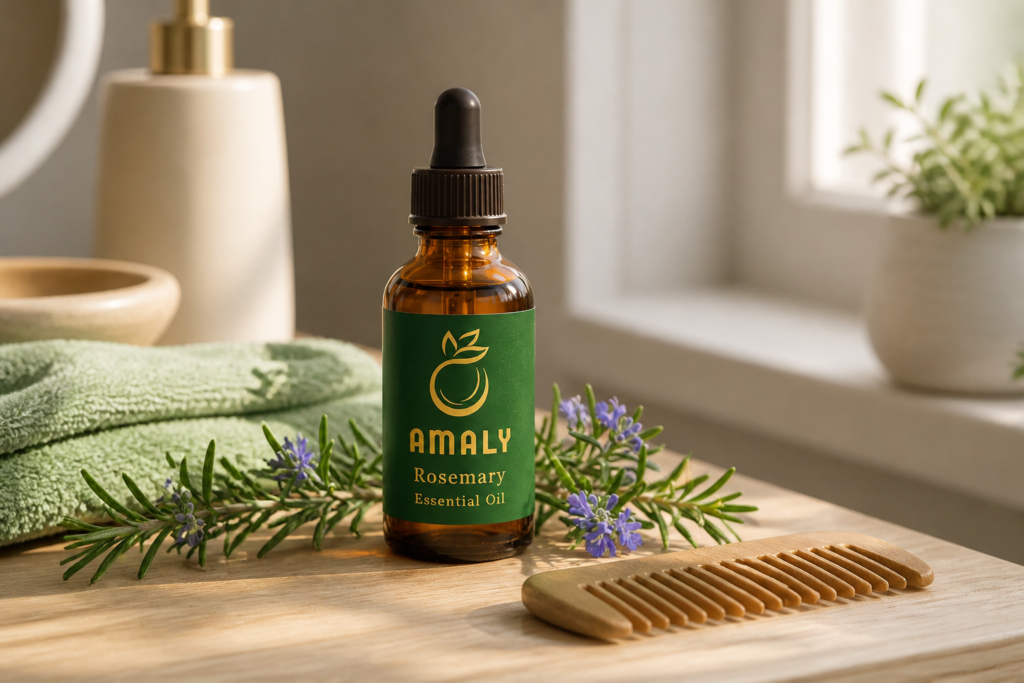
Rosemary oil in an Amaly dropper bottle with fresh rosemary and a wooden comb

Rosemary Oil for Hair & Skin: 4 Honest Benefits, How to Use & Side Effects

Written by the Amaly team. Sources are linked in the article. Last updated 15 November 2026. Key takeaways Rosemary oil is mainly a hair and scalp care oil: it adds shine, smells fresh and gives the scalp a cool, invigorating feeling. Rosemary (إكليل الجبل) is a herb. Rosemary essential oil is steam-distilled from its leaves. One small 2015 study looked at the oil and hair. It is interesting, but it is early research, not a promise. Pure rosemary essential oil must be diluted: up to 2 drops in 5 ml of carrier oil for a scalp oil, or 2-3 drops in one wash of shampoo. If you are losing a lot of hair, see a dermatologist. Hair loss has many causes that an oil cannot fix. Rosemary oil for hair is mainly a care product: it adds shine, smells fresh and gives the scalp a cool, invigorating feeling. It is also one of the most searched oils in Egypt, and one of the most over-promised. This guide covers what rosemary oil is, its real benefits for hair, scalp and skin, how much to use, what the research actually says, its side effects, and how to tell a real one. Is rosemary oil an essential oil? Yes. Rosemary essential oil comes from the leaves of rosemary (Rosmarinus officinalis), a Mediterranean herb from the mint family. In Arabic it is called both روزماري and إكليل الجبل. They are the same plant. The oil is made by steam distillation. “Rosemary oil” on a shelf can mean: Pure rosemary essential oil: concentrated and strong. Never on skin or scalp without diluting. Ready-to-use rosemary oil: a small amount of essential oil in a carrier oil, made to go straight on the scalp. Rosemary-infused oil or hair oil blends: rosemary leaves soaked in oil, or rosemary mixed with other oils. Rosemary oil benefits: what it really does These are the rosemary essential oil benefits that are honest to promise: Shine: a little oil on the lengths makes dull hair look glossier. A fresh scalp feeling: a cool, clean feeling during a scalp massage. A weekly hair routine: a calm 5-minute scalp massage before washing is a simple self-care habit. Scent: a fresh, herbal smell that many people find energising in the morning. Rosemary essential oil for hair growth: what the study really says You may have seen posts saying the oil “regrows hair” or “works like a medicine”. This comes from a small 2015 study in 100 men. It compared an oil preparation with a common hair-loss medicine applied to the scalp for six months. Both groups had more hair at six months, with no clear difference between them, and scalp itching was more common with the medicine. It is one small study. Larger studies are needed before anyone can say the oil grows hair. The study used its own preparation and routine, which is not the same as any oil you buy. Hair loss has many causes. If you are losing a lot of hair, or have bald patches, see a dermatologist first. So the honest answer: this oil is a pleasant part of a hair-care routine, and the research on hair growth is interesting but early. How to use rosemary oil for hair (step by step) Patch test: put a little of the oil you will use on the inside of your arm and wait 24 hours. If there is redness or itching, do not use it. Prepare: use a ready-to-use blend, or dilute pure rosemary essential oil (see the table below). Apply: part your hair in sections and put a few drops on your fingertips. Massage: massage the scalp gently for 3-5 minutes. Keep away from the eyes. Leave it: 30-60 minutes, or overnight if your scalp is comfortable. Wash: shampoo as usual. Oil can take two washes to come out of fine hair. Repeat: 2-3 times a week is enough. How much rosemary essential oil for hair? Use Pure rosemary essential oil Mix with Scalp oil (left on) Up to 2 drops (about 2%) 5 ml (1 teaspoon) carrier oil Shampoo 2-3 drops One wash of shampoo, not the whole bottle Ready-to-use blend A few drops straight on the scalp Drinking Never Good carrier oils for hair: coconut oil for dry hair, sweet almond oil for most hair types, and olive oil for a rich oil bath. More drops do not mean faster results, only more risk of irritation. Do I need to wash my hair after using rosemary oil? Yes, for most people. Leaving oil on for days can make the scalp feel heavy and attract dust. Wash it out within a day. A weekly rosemary oil bath for your hair type The Egyptian “hammam zeit” (oil bath) is the easiest way to fit this oil into a routine. Mix it fresh each time in a small glass bowl, and change the carrier oil to suit your hair. Hair type Carrier oil Mix How long Dry or curly Coconut or olive Up to 2 drops of pure rosemary in 5 ml, on scalp and lengths 1-2 hours, once a week Normal Sweet almond Up to 2 drops in 5 ml, scalp first 30-60 minutes, 1-2 times a week Fine or oily Sweet almond, a small amount 1 drop in 5 ml, scalp only 30 minutes, wash the same day Coloured or treated Sweet almond 1 drop in 5 ml, after a patch test 30 minutes, once a week Warm the bowl in a cup of hot water for a minute rather than heating the oil directly. Cover your hair with a shower cap or an old towel, then shampoo twice if your hair still feels heavy. How long until you see results? This is the question people ask most after “does it work”, so here is a realistic timeline. Right away: shine on the lengths, a fresh scent and a cool scalp feeling. After a few weeks: a routine you enjoy, and a scalp that feels clean and comfortable if

Rosemary Oil for Hair & Skin: 4 Honest Benefits, How to Use & Side Effects Read More »

Copilot 20251012 014616

Bergamot Oil: 5 Benefits, Easy Ways to Use It on Skin & Face, the Sun Rule

Written by the Amaly team. Sources are linked in the article. Last updated 15 November 2026. Key takeaways Bergamot oil has a calm, fresh citrus scent with a soft floral edge. It is the scent in Earl Grey tea. It is used in massage and scent blends and in relaxing evening routines. Regular oil reacts strongly with sunlight. On skin, use it in the evening and keep that skin out of the sun for 12-18 hours. Labels marked “FCF” or “bergapten-free” have the sun-reactive compounds removed. This oil is a scented oil, not a treatment for any skin condition. Bergamot oil is used mainly for its calm, relaxing citrus scent and in massage and scent blends. It is also the citrus oil with the strongest sun reaction, so how you use it matters. This guide covers what bergamot oil is, its real benefits, how to use it on skin, face, hair and in a diffuser, sun safety, side effects, and how to tell a real one. What is bergamot oil? Bergamot essential oil comes from the peel of the bergamot orange, Citrus bergamia, grown mostly in southern Italy. It is cold-pressed from the peel, like lemon oil. What is bergamot called in Egypt? It is usually sold as برغموت or برجموت. It is a citrus fruit, not the garden herb also called “bergamot” (bee balm). Natural bergamot oil contains bergapten, a compound that can make skin react badly to sunlight (redness, burning, dark marks). Some bottles have it removed and are labelled FCF (furocoumarin-free) or “bergapten-free”. Bergamot oil benefits: what it really does What are the benefits of bergamot oil? These are the bergamot essential oil benefits that are honest to promise: A calm citrus scent: a soft citrus-floral smell that many people enjoy in the evening. Massage and scent blends: bergamot mixes well with lavender, rose, geranium and ylang-ylang. Personal scent: a classic note in colognes and perfumes. A relaxing routine: a few drops after a shower at night as part of winding down. For the body: a soft-scented evening body oil, diluted. What does research say about bergamot oil? A review called “Citrus bergamia essential oil: from basic research to clinical application” collects research on bergamot, from lab studies to studies in people. The studies in people were about aromatherapy, mainly for stress and feeling anxious. Keep in mind: Lab and animal results do not show what happens when you use the oil at home. Human studies are mostly small and short. A calm scent can be part of a relaxing routine. If you often feel stressed or low, please talk to a doctor. Bergamot oil and the sun This is the most important part of using bergamot on skin: Use it on skin only in the evening. Keep that area out of the sun and tanning beds for at least 12-18 hours. If skin may see the sun, regular bergamot should stay at 0.4% or less (well under 1 drop in 5 ml of carrier oil), according to the Tisserand Institute. If the label does not say FCF or bergapten-free, assume it reacts with the sun. How to use bergamot oil (step by step) Patch test in the evening on the inside of your arm. Wait 24 hours. Dilute: pure oil must be diluted. A ready-to-use blend is already diluted. Evening massage: massage a few drops onto shoulders, arms or feet. Blend: mix with a little sweet almond oil for a larger massage. Scent: a drop on the wrists in the evening. Next day: keep that skin covered or out of the sun. Bergamot oil for skin Evening body oil: a few drops of ready-to-use blend on arms, legs or back after a shower. Bath: mix a drop with a spoon of carrier oil before adding to a warm evening bath. Skip broken or irritated skin. This oil does not lighten or even out skin colour. If you have patches or marks that worry you, see a dermatologist. Bergamot oil for face Only in the evening, well diluted or ready to use, after a patch test. No sun on the face for 12-18 hours. If you go out in the morning, skip bergamot on the face, unless it is FCF. Keep away from the eyes. Skip it on sensitive or irritated skin. Bergamot oil for hair Bergamot is mostly used in hair oils for its scent. A drop in an evening hair oil or scalp massage is enough. Do not leave regular bergamot on the scalp or hair parting before going out in the sun. Blend idea Mix with Mood Evening calm Bergamot + lavender Relaxed Floral Bergamot + geranium Soft, rosy Warm Bergamot + ylang-ylang Rich, floral Cosy Bergamot + frankincense Warm, quiet Bergamot oil for diffuser In a diffuser, the sun reaction is not a problem, because the oil is not on your skin. Use a pure bergamot oil, not a ready-to-use carrier blend. Most diffuser makers say not to put carrier oils in the water tank. Run it for 30-60 minutes in the evening, then turn it off, and keep the room ventilated. Keep diffusers away from babies and pets. Bergamot oil side effects Sun reaction: redness, burning or dark marks if skin goes into the sun after using regular bergamot. Evening only, and no sun for 12-18 hours. Skin irritation or allergy: patch test and stop if irritated. Citrus allergy: avoid. Pregnancy and breastfeeding: ask your doctor first. Children: keep out of reach. Do not use on children without a doctor’s advice. Eyes: keep away. If it gets in your eye, rinse with plenty of clean water and see a doctor if it still stings. Never swallow essential oils. Regular medicines or a chronic condition: ask your doctor or pharmacist before using essential oils often. For external use only. Not a substitute for medical advice. Tips for every reader Just curious: bergamot is the citrus fruit that gives Earl Grey tea its scent. Its oil is mainly used for a calm citrus

Bergamot Oil: 5 Benefits, Easy Ways to Use It on Skin & Face, the Sun Rule Read More »

Geranium Oil: Benefits, Uses for Skin & Face, Side Effects

Key takeaways Geranium oil has a soft, rosy-green scent. It is used in skincare, massage and as a light natural perfume. It comes from rose geranium (Pelargonium graveolens), known in Egypt as العتر. Egypt is one of the countries that grows and exports it. On skin it is used to leave skin looking balanced and fresh. It is a scented oil, not a medicine. Pure geranium essential oil must be diluted before it touches skin. A ready-to-use oil is already blended for skin. Always check which one you have. A ready-to-use oil is for skin. For a diffuser, you need a pure essential oil. In this guide What is geranium? (the plant and the oil) What does geranium oil smell like? Geranium oil benefits: what it really does Ready-to-use vs pure geranium oil Geranium oil for skin Geranium oil for face How to use geranium oil: more ideas Geranium oil for diffuser Geranium oil side effects Geranium oil for every reader Common myths about geranium oil How to tell if geranium oil is real Geranium oil price in Egypt: what you are paying for Geranium oil vs rose oil: which one to choose? Frequently asked questions Try Amaly geranium oil Geranium oil is used mainly for its soft, rose-like scent and to leave skin looking balanced and fresh. It is often called “the poor man’s rose” because it smells close to rose for a fraction of the price. This guide covers what geranium oil is, its real benefits, how to use it on your skin, face and in a diffuser, its side effects, how to tell a real one from a fake, and what it costs in Egypt. What is geranium? (the plant and the oil) The geranium used for essential oil is rose geranium, Pelargonium graveolens. It is a green, leafy herb with small pink flowers, and its leaves smell like rose when you rub them. In Egypt it is known as العتر, and many Egyptian homes grow it in a pot. It is not the same plant as the red balcony “geranium” flowers, even though they share the name. Geranium essential oil is made by steam-distilling the leaves and stems. Egypt is one of the countries that produces and exports essential oils such as geranium and jasmine for the world’s perfume and cosmetics makers (Egypt’s essential oil exports were about 46 million US dollars in 2023). What does geranium oil smell like? Like rose, with a fresh, green, slightly minty edge. It is lighter and greener than real rose oil. That is why perfumers use it to make rose scents fuller, and why it appears in both women’s perfumes and fresh colognes. Geranium oil benefits: what it really does Here are the geranium essential oil benefits that are honest to promise: A soft, rosy scent: a light natural fragrance for your skin, clothes or home. Skin that looks balanced and fresh: used in an evening routine, it leaves skin looking fresh and feeling soft (the carrier oil helps here too). A relaxing massage: its floral scent makes a body massage feel like a spa moment. A good blending oil: it pairs well with rose, lavender, bergamot and citrus oils. You will see bigger promises online. Here is what the evidence actually supports: most studies on geranium oil are done in the lab (on cells in a dish) or on animals. These results do not show what happens when you use the oil at home. The US National Center for Complementary and Integrative Health notes that research on essential oils in people is still limited. If you have a skin or health problem, see a doctor. Ready-to-use vs pure geranium oil This is the most important thing to understand before you buy or compare prices. Pure essential oil Ready-to-use oil What it is 100% geranium essential oil A small amount of geranium essential oil blended in a carrier oil (about 1%) On skin Never neat. Must be diluted first Ready to use straight from the bottle In a diffuser Yes No (carrier oil can clog a diffuser) Price Higher per ml Lower per bottle So a pure bottle and a ready-to-use bottle are different products, not two prices for the same thing. Always check the label: “pure” or “diluted / ready to use”. Geranium oil for skin Patch test first: put a little on the inside of your arm and wait 24 hours. If you see redness or itching, do not use it. Body: massage a few drops onto damp skin after a shower, when skin absorbs oil best. Dry areas: elbows, knees and heels, a few drops in the evening. For a larger massage: mix with a light carrier like sweet almond oil or grape seed oil. Using a pure geranium essential oil? Mix 1 drop in 1 teaspoon (5 ml) of carrier oil for the face (about 1%), and up to 2 drops in 5 ml for the body (about 2%). Geranium oil for face Cleanse your face at night and pat it dry. Warm 2-3 drops of ready-to-use geranium oil between your fingertips. Press gently onto cheeks, forehead and chin. Keep away from the eyes and lips. Use it in the evening. Start every other night and see how your skin feels. If your skin has a problem that hurts, spreads or does not go away, see a dermatologist instead of trying oils. How to use geranium oil: more ideas Personal scent: a drop on the wrists and behind the ears. Hair ends: one or two drops smoothed on dry ends for a soft shine and a rosy scent. Clothes and drawers: a drop on a cotton ball in a drawer (not directly on fabric, it can stain). Bath: a few drops of ready-to-use oil in warm bath water. The floor of the bath can get slippery. Blend Mix geranium with Result Rosy rose oil Rich floral Fresh bergamot oil (evening only, sun-sensitive) Floral citrus Calm lavender oil Soft, relaxing Warm ylang-ylang oil Deep, sweet

Geranium Oil: Benefits, Uses for Skin & Face, Side Effects Read More »

Frankincense Oil: Benefits, Uses for Face & Skin, Side Effects

Key takeaways Frankincense oil has a warm, rich, woody-citrus scent and thousands of years of history, including in ancient Egypt. Today it is used mainly for scent, quiet evening moments, massage blends and perfume. Research on boswellia is mostly about supplements and lab studies, not the essential oil on skin. Pure frankincense essential oil must be diluted before it touches skin. It works well in a diffuser. Frankincense resin (اللبان الذكر), frankincense oil and “frankincense creams” are three different products. In this guide What is frankincense oil? A short history What does frankincense oil smell like? Frankincense oil benefits: what it really does Frankincense resin vs oil vs cream How to use frankincense oil (step by step) Frankincense oil for face Frankincense oil for skin Frankincense oil for diffuser A relaxing frankincense massage at home Frankincense oil side effects Frankincense oil for every reader Common myths about frankincense oil How to spot a real frankincense oil Frankincense oil price in Egypt: what you are paying for Frequently asked questions Warm oils from Amaly Frankincense oil is used mainly for its warm, rich scent: in quiet evening moments, perfume and relaxing massage blends. It has a long and beautiful history, and also a lot of exaggerated claims online. This guide covers what frankincense oil is, its real benefits, how to use it on your face and skin, in a diffuser and in massage, its side effects, how to spot a real one, and what it costs in Egypt. What is frankincense oil? Frankincense (اللبان) is a resin from Boswellia trees that grow in Oman, Yemen, Somalia and the Horn of Africa. The trees “bleed” a sap that dries into tears of resin. Steam-distilling this resin gives frankincense essential oil. Resin: the dried sap of the tree. In Egypt the best-known kind is called اللبان الذكر (also spelled “laban dakar”). Olibanum: another name for frankincense resin. Boswellia sacra, carterii, serrata: different species. The oil from each smells a little different. A short history Ancient Egyptians burned frankincense in temples and used it in perfumes and rituals. It was traded across Arabia for centuries and is still burned as incense in homes across the region. Its scent is linked with calm and ceremony in many cultures, which is why it is still a favourite in Ramadan and on special occasions. What does frankincense oil smell like? Warm, woody and resin-like, with a fresh, slightly lemony top. It is softer and cleaner than burning resin, with no smoke. Frankincense oil benefits: what it really does These are the frankincense essential oil benefits that are honest to promise: A warm, rich scent: a calm, elegant smell for your home or skin. A calm evening routine: many people like its scent in quiet time before bed or during meditation. A relaxing massage: diluted in a carrier oil, it gives a warm scent to a back or shoulder massage. Perfume: a classic base note in oriental perfumes. Skin that feels soft: in an evening routine, the carrier oil leaves skin feeling soft and the frankincense adds scent. What does research say? Most research is on boswellia extracts and supplements, or done in the lab on cells. Lab results do not show that a product works in people. The US National Center for Complementary and Integrative Health (NCCIH) page on boswellia explains that research in people is limited and more studies are needed. If you have a health condition, or pain that does not go away, see a doctor. Frankincense resin vs oil vs cream Product What it is How it is used Sold by Resin (اللبان الذكر) Dried tree sap, in “tears” Burned on charcoal, traditional uses Weight (grams or kilo) at attar shops Essential oil Steam-distilled resin, very concentrated Diluted on skin, diffuser, massage Small bottles (ml) “Frankincense” creams A cosmetic cream that contains some frankincense As the label says Tubes and jars Incense sticks Often mixed with other materials Home scent Packs So if you see “the price of a kilo of frankincense”, that is the resin, not the oil. Oil is sold by the ml and costs much more per gram because it takes a lot of resin to make a little oil. If you burn resin or incense at home, keep the room ventilated and keep smoke away from babies and anyone who finds smoke hard to breathe. How to use frankincense oil (step by step) Dilute: mix 1 drop of pure frankincense essential oil with about 1 teaspoon (5 ml) of carrier oil such as sweet almond or sesame oil. That is about 1%. For the body you can go up to 2 drops in 5 ml (about 2%). Patch test: put the blend on the inside of your arm and wait 24 hours. Use it: on the body, the face (below), in massage or as a scent. Check the oil: frankincense oil that smells sharp or “off” has oxidised. Do not use it on skin. Frankincense oil for face Use a well-diluted blend (1 drop in 5 ml carrier oil) or a ready-to-use oil. Cleanse at night, then press 2-3 drops of the blend onto cheeks, forehead and chin. Keep away from the eyes and lips. Start every other night and see how your skin feels. When will I see results on my face? Frankincense oil is a scented cosmetic oil, not a treatment, so there is no “result date” to promise. Skin usually feels softer straight after use because of the carrier oil. If you are trying to fix dark spots, marks or any skin problem, see a dermatologist, who can tell you what will actually help. Frankincense oil for skin Using frankincense essential oil for skin is simple if you keep it diluted: Body oil: 1-2 drops of pure oil in 5 ml carrier oil, massaged onto damp skin after a shower. Dry areas: elbows, hands and heels in the evening. Never neat: pure frankincense essential oil should not go straight on skin. Broken or irritated skin: do

Frankincense Oil: Benefits, Uses for Face & Skin, Side Effects Read More »

Copilot 20251013 001635

Chamomile Oil: 5 Benefits for Relaxed Evenings, Roman vs German, How to Use

Written by the Amaly team. Sources are linked in the article. Last updated 15 November 2026. Key takeaways There are two main chamomile oils: Roman (soft, apple-like scent) and German (deep blue, herbal). This oil is used for its soft, calming scent, in gentle massage and in evening routines. Most chamomile research is about the tea and extracts, not the essential oil on skin. People allergic to plants in the daisy family (ragweed, daisies, marigolds) can react to chamomile. On the face, use 1% or less (1 drop in 5 ml of carrier oil) after a patch test. Chamomile oil is used mainly for its soft, calming scent and in gentle routines for skin, face and hair. Chamomile is one of the best-known herbs in the world, and Egypt is one of its big growers. This guide explains the two types of chamomile essential oil, its real benefits and uses, what research covers, how to use it, side effects, and how to tell a real one. What is chamomile oil? Chamomile essential oil is steam-distilled from chamomile flowers. Two kinds are sold, and they are different oils: Roman chamomile German chamomile Latin name Chamaemelum nobile (also Anthemis nobilis) Matricaria chamomilla (also M. recutita) Colour Pale yellow, almost clear Deep blue (from chamazulene, formed during distillation) Scent Soft, sweet, apple-like Strong, herbal, a little earthy Best for Scent, evening blends, massage Gentle skin blends The blue colour of German chamomile is natural. It can fade to green or brown as the oil ages. A good label always says which chamomile is in the bottle. Chamomile oil benefits: what it really does These are the benefits that are honest to promise: A soft, calming scent: Roman chamomile is a favourite for evenings. Gentle massage: diluted in a carrier oil, it suits a slow, relaxing massage. Evening routine: a calm scent as part of winding down before bed. Gentle skin blends: a small amount in a body or face oil, after a patch test. Blending: it mixes well with lavender, bergamot, rose and geranium. Uses of chamomile oil A few drops (pure oil) in a diffuser in the evening. A diluted evening massage oil for shoulders, back or feet. One drop of pure oil in a carrier oil for a warm evening bath. A drop in a body oil or a face oil (see the face section below). A drop in a hair oil for scent. What does research say about chamomile? The US National Center for Complementary and Integrative Health (NCCIH) summarises the research. Most of it looks at chamomile tea, capsules and extracts, not the essential oil on skin. Key points: There is very little research on chamomile and sleep. A 2019 review found only one sleep study, and it showed no benefit. Results for tea and capsules do not tell you what the essential oil does on skin. Chamomile can cause allergic reactions, especially in people allergic to the daisy family. A calm scent can be part of a good bedtime routine. If you often struggle to sleep, please see a doctor. How to use chamomile oil (step by step) Check allergies: if you are allergic to ragweed, daisies, marigolds or chrysanthemums, skip it. Patch test: a small amount, diluted, on the inside of your arm. Wait 24 hours. Dilute: pure oil must be diluted. Body: 2% (about 2 drops in 5 ml of carrier oil). Face: 1% or less (1 drop in 5 ml). Massage: warm the oil in your hands and massage slowly. Blend: mix with sweet almond oil for a light, gentle base. Chamomile oil for skin A drop in a body oil after a shower is a gentle way to enjoy it. Skip broken, sore or irritated skin. This oil is a scented oil, not a skin treatment. If a rash, redness or itching does not go away, see a dermatologist. Chamomile oil for face Use 1% or less (1 drop in 5 ml of a light carrier oil), after a patch test. Keep it away from the eyes. Stop if your skin turns red, itchy or tight. Chamomile does not react with the sun like bergamot or cold-pressed lemon, but it can still irritate sensitive skin. Chamomile oil for hair Chamomile is added to hair oils mainly for its scent. Add 1 drop to a spoon of carrier oil for a scalp massage, or 1-2 drops to one wash of shampoo. There is no good evidence that the oil lightens hair colour; that idea comes from rinsing with chamomile tea. Blend idea Mix with Mood Evening calm Roman chamomile + lavender Soft, sleepy Calm citrus Chamomile + bergamot Fresh, relaxed Floral Chamomile + rose Gentle, rosy Warm Chamomile + frankincense Quiet, cosy Chamomile oil side effects Allergy: people allergic to ragweed or the daisy family can react to chamomile. Patch test first. Skin irritation: stop if you see redness, itching or a rash. Pregnancy and breastfeeding: ask your doctor first. Children: keep out of reach. Do not use on children without a doctor’s advice. Eyes: keep away. If it gets in your eye, rinse with plenty of clean water and see a doctor if it still stings. Never swallow essential oils. Regular medicines or a chronic condition: ask your doctor or pharmacist before using chamomile often. For external use only. Not a substitute for medical advice. Tips for every reader Just curious: this oil is distilled from the flowers. Roman smells like soft apple, German is blue and herbal. First time with oils: start with Roman chamomile in a diffuser in the evening. Sensitive skin: patch test, keep it at 1% on the face, and stop if irritated. Allergic to daisies or ragweed: skip chamomile. Trouble sleeping: a calm scent can help you wind down. If it happens often, see a doctor. Scent lovers: chamomile adds a soft, sweet note to lavender or bergamot. Pregnant or breastfeeding: ask your doctor first. Parents: keep bottles out of children’s reach. Massage at home: chamomile with sweet

Chamomile Oil: 5 Benefits for Relaxed Evenings, Roman vs German, How to Use Read More »

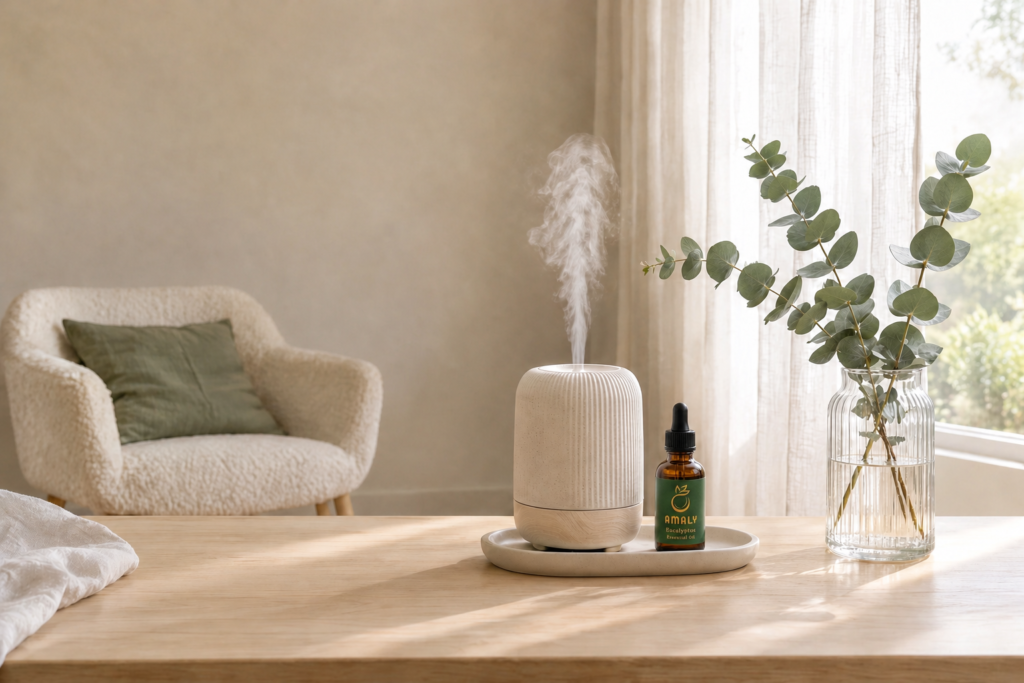
Diffuser in a bright room with eucalyptus stems and an Amaly eucalyptus oil bottle

Eucalyptus Oil: 4 Useful Benefits, How to Use, Diffuser Tips & Side Effects

Written by the Amaly team. Sources are linked in the article. Last updated 15 November 2026. Key takeaways Eucalyptus oil has a fresh, sharp, camphor-like scent. It is used for a refreshing massage and a clean-smelling home. Yes, it is an essential oil, steam-distilled from eucalyptus leaves. In Egypt the eucalyptus tree is often called كافور, but camphor oil is a different oil. It is strong. Pure oil must be diluted before it touches skin. Never use the oil on or near the face of children under 10. As little as 2 ml swallowed can seriously poison a baby. Its fresh smell is popular in winter, but it is not a treatment. If you or your child are unwell, see a doctor. Eucalyptus oil is used mainly for its fresh, cooling scent and for a refreshing massage. It is one of the most recognisable essential oils, and one that needs real care around children. This guide covers what eucalyptus oil is, its real benefits, how to use it on skin and in a diffuser, its side effects, child safety, and how to tell a real one. Is eucalyptus oil an essential oil? Yes. Eucalyptus essential oil is steam-distilled from the leaves of eucalyptus trees, most often Eucalyptus globulus or Eucalyptus radiata. Its main compound, 1,8-cineole (also called eucalyptol), gives the sharp, fresh smell. In Egypt many people call the eucalyptus tree كافور, so “زيت الكافور” can mean different things. True camphor oil comes from a different tree (Cinnamomum camphora). Always check the Latin name on the label. Eucalyptus oil benefits: what it really does What are the benefits of eucalyptus oil? These are the eucalyptus essential oil benefits that are honest to promise: A fresh, cooling scent: sharp and clean, popular in winter and after a shower. A refreshing massage: diluted, on the back, shoulders, legs and feet after a long day or the gym. A clean-smelling home: in a diffuser or a cleaning spray. Fresh feet: in a diluted foot massage. What does research say about eucalyptus oil? The US National Center for Complementary and Integrative Health (NCCIH) notes that research on aromatherapy and essential oils in people is still limited. Eucalyptus is in many winter rubs and steam products, but a fresh smell is not a treatment. If you have a fever, trouble breathing or feel unwell for more than a few days, see a doctor. How to use eucalyptus oil (step by step) Patch test: put a little diluted oil on the inside of your arm and wait 24 hours. Dilute: 1 drop of pure oil in 5 ml carrier oil (about 1%), up to 2 drops in 5 ml (about 2%) for the body. A ready-to-use blend is already diluted. Massage: rub into the back, shoulders, legs or feet with slow strokes. Wash your hands afterwards, and keep away from the eyes. For a bigger area, mix with sesame oil or coconut oil for more glide. Question Quick answer Face? Not recommended. Keep it on the body. Body / massage? Up to 2 drops pure oil in 5 ml carrier oil Children under 10? Never on or near their face; ask a doctor before any use Swallow? Never – dangerous Eucalyptus oil for diffuser Use a pure eucalyptus essential oil, not a ready-to-use carrier blend. Most diffuser makers say not to put carrier oils in the water tank. Follow your diffuser’s instructions for the number of drops. Run it for 30-60 minutes, then turn it off, and keep the room ventilated. Do not diffuse eucalyptus in a room with babies or young children. Keep diffusers away from pets. Winter idea: eucalyptus with lemon or tea tree for a fresh, clean-smelling home. No diffuser? Put a drop of pure eucalyptus on a tissue near you (adults only). Do not put drops into hot water to breathe in; strong vapour can sting the eyes and nose. Eucalyptus oil side effects Children: never on or near the face or chest of children under 10. Ask a doctor before any use on a child. Swallowing is dangerous: keep the bottle locked away. As little as 2 ml (less than half a teaspoon) can cause serious poisoning in a baby, according to the Western Australia Department of Health. Children’s hospitals treat swallowed eucalyptus oil as an emergency. Call a doctor or poison centre straight away. Skin irritation: pure eucalyptus can redden and irritate skin. Always dilute and patch test. Eyes: keep away. If it gets in your eye, rinse with plenty of clean water and see a doctor if it still stings. Pregnancy and breastfeeding: ask your doctor first. Regular medicines or a chronic condition: ask your doctor or pharmacist before using essential oils often. Pets: keep bottles and diffusers away from them. For external use only. Not a substitute for medical advice. Tips for every reader Just curious: this oil comes from eucalyptus leaves (the Egyptian “كافور” tree) and is mainly used for a fresh scent and massage. Parents: keep eucalyptus away from babies’ and young children’s faces and chests, keep the bottle locked away, and see a doctor when your child is unwell. Gym-goers and active people: a diluted eucalyptus massage after training feels cool and fresh. Office workers: a neck and shoulder massage with a diluted eucalyptus blend after a long day. First time with oils: start with a diffuser in an adults-only room, or a 1% body massage. Sensitive skin: stay at 1% and keep it off the face. Pregnant or breastfeeding: ask your doctor first. Home lovers: eucalyptus in a cleaning spray or diffuser for a fresh home. Pet owners: keep it away from cats and dogs. Checking value: look at the Latin name, pure or ready to use, and the size (see below). Common myths Myth: eucalyptus oil is the same as camphor. Fact: in Egypt the tree is called كافور, but camphor oil comes from a different tree. Myth: rubbing it on a child’s chest is a safe home habit. Fact: never use

Eucalyptus Oil: 4 Useful Benefits, How to Use, Diffuser Tips & Side Effects Read More »

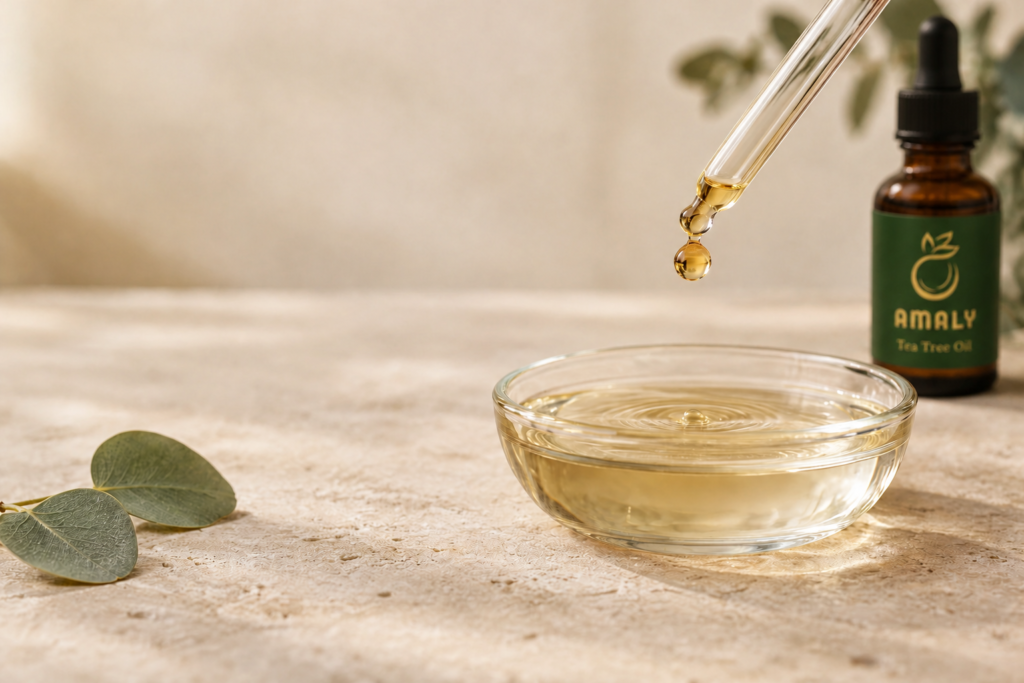
One drop of oil going into a small dish of carrier oil to dilute it

Tea Tree Oil: 4 Benefits for Skin & Face, Safe Dilution & Side Effects

Written by the Amaly team. Sources are linked in the article. Last updated 15 November 2026. Key takeaways Tea tree oil has a fresh, sharp, medicinal scent and leaves skin and scalp feeling clean. Yes, it is an essential oil, steam-distilled from the leaves of the Australian Melaleuca alternifolia tree. It has nothing to do with the tea we drink. It is strong. Pure oil must be diluted: 1 drop in 5 ml of carrier oil for the face. Some small studies have looked at tea tree products for skin, but more and better research is needed. This oil is poisonous if swallowed. Keep it away from children and pets. Tea tree oil is used mainly in skin and scalp routines for the clean, fresh feeling it leaves behind. It is one of the best-known essential oils, and one of the easiest to misuse. This guide covers what tea tree oil is, its real benefits, exactly how to dilute it for skin, face and scalp, what research says, its side effects, and how to tell a real one. Is tea tree oil an essential oil? Yes. Tea tree essential oil is steam-distilled from the leaves of Melaleuca alternifolia, a tree native to Australia. In Arabic it is called زيت شجرة الشاي. Despite the name, it has nothing to do with the tea we drink. Two words you will see: Essential oil: the concentrated aromatic oil. Tea tree essential oil can irritate skin if used undiluted. Carrier oil: a gentle plant oil, such as grape seed or sweet almond, used to dilute it. You will also find ready-to-use blends (already diluted) and tea tree shampoos, washes and creams, which contain small amounts. Tea tree oil benefits: what it really does What are the benefits of tea tree oil? These are the tea tree essential oil benefits that are honest to promise: A clean, fresh feeling on oily skin when used well diluted. A fresh scalp when a few drops go into one wash of shampoo. Fresh feet after a long day, in a diluted foot massage or foot soak. A clean-smelling home in a cleaning spray. What does research say about tea tree oil? The US National Center for Complementary and Integrative Health (NCCIH) summarises the research. In short: Some small studies have looked at tea tree products for skin concerns. The results are interesting, but more and better research is needed. This oil can cause skin irritation and allergic reactions, especially if it is old or used undiluted. It is toxic when swallowed. If you have spots that hurt, a scalp that is flaky or itchy most of the time, or any skin problem that does not go away, see a dermatologist. How to use tea tree oil (step by step) Choose a carrier oil: grape seed oil is light and good for oily skin; sweet almond for dry skin. Mix: 1 drop of pure tea tree essential oil in about 1 teaspoon (5 ml) of carrier oil for the face (about 1%). Up to 2 drops per teaspoon for the body or feet. Patch test: put a little on the inside of your arm and wait 24 hours. Apply: dab a small amount on clean skin with a cotton bud. Avoid the eyes and lips. Shampoo: add 2-3 drops to one wash of shampoo, not the whole bottle. Use Pure tea tree essential oil Mix with Face 1 drop 5 ml carrier oil Body / feet 2 drops 5 ml carrier oil Shampoo 2-3 drops One wash of shampoo Swallow Never – toxic Tea tree oil for skin Oily areas: a well-diluted drop (1%) on the T-zone with a cotton bud, in the evening. Feet: a 2% foot massage after a long day, or a few drops of pure oil in a tablespoon of carrier oil added to a foot soak. Underarms: some people add tea tree to a home deodorant. The evidence is limited, and never put it on freshly shaved or broken skin. Never on broken or irritated skin. Tea tree oil for face Tea tree is one of the strongest oils for the face, so go slowly: Use only 1% (1 drop in 5 ml carrier oil), or a ready-to-use oil. Patch test first, ideally on the jawline. Dab only where needed with a cotton bud, not all over the face. Start 2-3 evenings a week. Stop if your skin turns red, dry or stings. Spots that are painful, deep or lasting need a dermatologist, not oil. Tea tree oil for hair and scalp 2-3 drops in one wash of shampoo give the scalp a fresh, clean feeling. Rinse well and keep away from the eyes. Do not put pure oil straight on the scalp. If your scalp is flaky or itchy most of the time, see a dermatologist. For children’s scalp problems from school, ask a pharmacist for an approved product. Do not use essential oils on children’s scalps without advice. Tea tree oil side effects Never swallow tea tree oil. It is toxic. If a child swallows it, call a doctor or poison centre straight away. Never use it undiluted on skin or scalp. Skin irritation and allergy: redness, itching or rash. Old, oxidised oil irritates more, so keep the cap closed and the bottle cool and dark. Pregnancy and breastfeeding: ask your doctor first. Children: keep the bottle out of reach. Do not use on children without a doctor’s advice. Pets: keep bottles and diffusers away from cats and dogs. Eyes: keep away. If it gets in your eye, rinse with plenty of clean water and see a doctor if it still stings. For external use only. Not a substitute for medical advice. Tips for every reader Just curious: this oil comes from an Australian tree, not the tea plant, and is mainly used for a clean feeling on skin and scalp. Teens and young adults with oily skin: 1% on oily areas only, patch test, and see a dermatologist for painful

Tea Tree Oil: 4 Benefits for Skin & Face, Safe Dilution & Side Effects Read More »

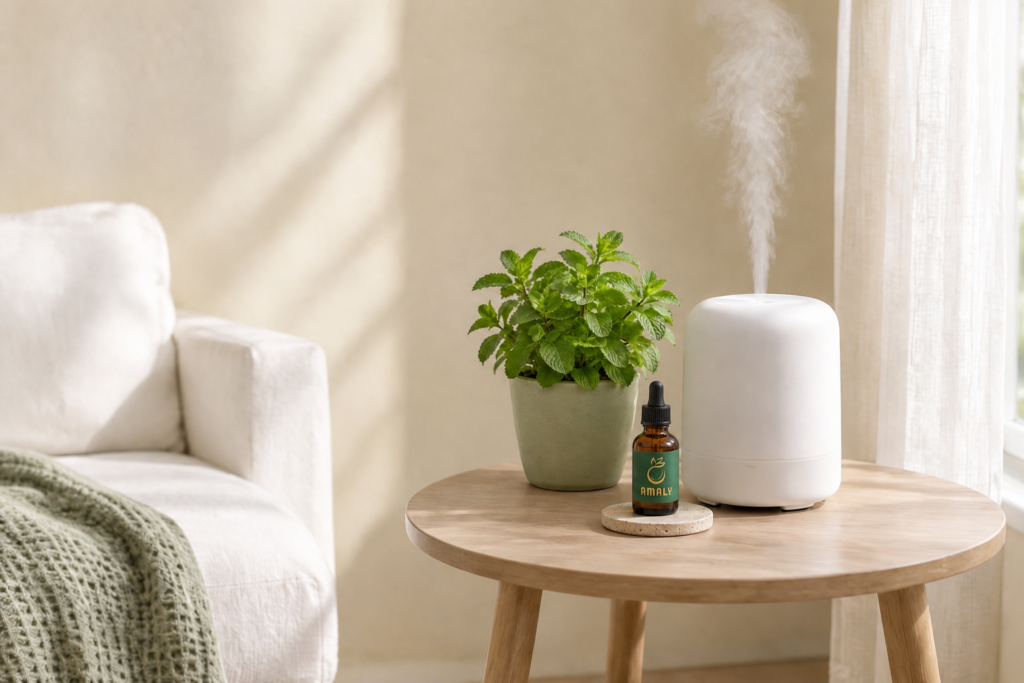
Diffuser releasing mist next to a mint plant and an Amaly peppermint oil bottle

Peppermint Oil: 5 Cool Benefits, How to Use on Skin & Hair, Side Effects

Written by the Amaly team. Sources are linked in the article. Last updated 15 November 2026. Key takeaways Peppermint oil gives a cool, fresh feeling on skin and scalp and has an energising minty scent. Yes, the oil is an essential oil: it is steam-distilled from the peppermint plant (Mentha × piperita). Its cooling comes mainly from menthol. It is strong. Pure peppermint essential oil must be diluted before it touches skin. Never use the oil on the face or near the nose of babies and young children. Never drink peppermint essential oil. The capsules studied in research are a different, medical product. Peppermint oil is used mainly for the cool, refreshing feeling it gives skin and scalp, and for its energising scent. It is one of the most useful oils for a home massage, and one of the strongest, so how you use it matters. This guide covers what peppermint oil is, its real benefits, how to use it on skin, face, scalp and in a diffuser, its side effects, child safety, and how to tell a real one. Is peppermint oil an essential oil? Yes. Peppermint essential oil is steam-distilled from the leaves of the peppermint plant, Mentha × piperita. In Arabic it is often called زيت النعناع الفلفلي. Its main compound, menthol, gives the famous cool feeling. But “peppermint oil” can mean different products: Pure peppermint essential oil: very concentrated. Never on skin without diluting. Ready-to-use peppermint oil: a small amount of essential oil blended in a carrier oil, made for skin. Peppermint capsules: a medical product taken by mouth, only on a doctor’s advice. Not the same as the oil in a bottle. Mint-scented oil: a plant oil with mint fragrance added. Peppermint oil benefits: what it really does These are the peppermint essential oil benefits that are honest to promise: A cooling, fresh feeling on skin and scalp. An energising scent: many people like it in the morning or during a study or work break. A refreshing massage: on tired legs, feet, neck and shoulders after a long day or the gym. A clean, fresh scalp feeling when a few drops go into shampoo. Fresh feet: a cool foot massage on a hot day. What does research say about peppermint oil? The US National Center for Complementary and Integrative Health (NCCIH) explains that most good research on the oil is about special capsules taken by mouth for the stomach and gut, used under medical advice. Very little research has looked at the oil used on the skin at home. So the cool feeling is real, but the oil is not a treatment. If you have pain, headaches or stomach problems that keep coming back, please see a doctor. Peppermint oil for skin Patch test first: put a little diluted oil on the inside of your arm and wait 24 hours. Dilute: mix 1 drop of pure peppermint essential oil in 1 teaspoon (5 ml) of carrier oil (about 1%). Up to 2 drops in 5 ml (about 2%) for the body. A ready-to-use blend is already diluted. Massage: rub into tired legs, feet, neck or shoulders. Wash your hands after use, and do not touch your eyes. For a larger area, mix with coconut oil or sesame oil. For a stronger cool massage, Amaly peppermint and camphor oil is a ready-made blend. Peppermint oil for face Peppermint is one of the strongest oils for the face, so be careful: Only very diluted (1 drop in at least 5 ml carrier oil), or a ready-to-use oil, after a patch test. Keep it well away from the eyes. The cooling vapour alone can sting. Skip it on sensitive, dry or irritated skin. A plain carrier oil is kinder. Never on the face or near the nose of babies and young children. Peppermint oil for hair and scalp “Peppermint oil for hair” is one of the biggest searches in Egypt. What it honestly does: it gives the scalp a cool, fresh, clean feeling. In shampoo: 2-3 drops of pure oil in one wash of shampoo, not in the whole bottle. Rinse well and keep away from the eyes. Scalp massage: a few drops of ready-to-use oil, or 1-2 drops of pure oil in 5 ml of carrier oil, massaged in for a few minutes before washing. If you are losing a lot of hair or your scalp is itchy or flaky most of the time, see a dermatologist. How to use peppermint oil, step by step If this is your first bottle, these five steps keep it simple and safe. Read the label. It should say whether the oil is pure or ready to use. Pure oil is never used straight on the skin. Dilute pure oil. 1-2 drops in 5 ml (one teaspoon) of a carrier such as coconut oil or sesame oil. That is about 1-2%. Patch test. Put a little of the mix on the inside of your forearm and wait 24 hours. Use a small amount. Keep it away from the eyes, and wash your hands well afterwards. Stop if it stings. A cool tingle is normal. Burning, redness or itching is not: wash the area with a little carrier oil, then soap and water. Peppermint oil for headache: a cool feeling on the temples Many people reach for this oil when their head feels heavy after a long day at the screen. The cool feeling on the temples is what they like. The NCCIH describes the research on headaches as small, so treat it as a comfort, not a medicine. Mix 1 drop of pure oil in a teaspoon of carrier oil, or use a ready-to-use oil. Rub a little on the temples and the back of the neck. Never on the forehead close to the eyes, and never on children. Take a break from the screen, drink water and rest your eyes too. If your headaches are frequent, strong, new for you, or come with other symptoms, see a doctor. After

Peppermint Oil: 5 Cool Benefits, How to Use on Skin & Hair, Side Effects Read More »