
Key takeaways
- Rose oil is loved for its rich, natural rose scent and the soft, fresh feeling it leaves on skin.
- Real rose essential oil comes from the Damask rose (Rosa damascena). It takes a huge amount of petals to make a little oil, so it is expensive.
- Cheap “rose oil” is usually a carrier oil with rose fragrance added. It can smell nice, but it is a different product.
- Research on rose aromatherapy for mood and sleep is encouraging, but larger studies are still needed.
- This oil does not lighten skin. It is a scented skin oil, not a treatment.
In this guide
Rose oil is used mainly for its luxurious scent and to leave skin feeling soft and fresh. It is one of the most loved oils in Egypt, and one of the most faked. This guide explains what it is, its real benefits for skin and face, how to use it on the body and in a diffuser, why the real thing is expensive, how to tell a real one from a scented one, and who should avoid it.

What is rose oil?
Rose essential oil usually comes from the Damask rose, Rosa damascena. In Egypt people often call local roses الورد البلدي. There are two main kinds made from the petals:
- Rose otto essential oil (steam-distilled): steam carries the scent out of the petals. This is the classic rose essential oil. Pure rose otto can turn cloudy or partly solid in the cold, which is normal.
- Rose absolute (solvent-extracted): a deeper, heavier smell, mainly used in perfume.
You will also see two other products called “rose oil”:
- Rose-scented oil: a plant oil with rose fragrance added. Cheaper, and not rose essential oil.
- Ready-to-use rose oil: a small amount of real rose essential oil blended in a carrier oil, made to go straight on skin.

What does it smell like?
Real rose smells deep, rich and slightly green, with a soft honey note. A sharp, soapy or very sweet smell usually means added fragrance.
Rose oil benefits: what it really does
These are the rose essential oil benefits that are honest to promise:
- A luxurious scent: a natural rose smell that works as a light personal perfume.
- Soft, fresh-feeling skin: in an evening routine, it leaves skin feeling soft and looking fresh.
- A relaxing routine: many people enjoy the smell of rose before sleep or after a long day.
- Massage: rose adds a special scent to a body massage.
- A classic gift: for mothers, brides and friends, especially around Mother’s Day, weddings and Eid.
What does research say about rose oil?
Most research on rose essential oil looks at aromatherapy, meaning breathing in the scent. A systematic review and meta-analysis on Rosa damascena aromatherapy pooled 28 randomised trials on mood and sleep. The authors report encouraging results in the people studied and say larger trials are still needed.
The US National Center for Complementary and Integrative Health (NCCIH) notes that aromatherapy research is still limited overall. A pleasant scent can be part of a relaxing routine. If sleep or mood is a problem most days, please talk to a doctor.
Rose oil for skin
- Patch test first: put a little on the inside of your arm and wait 24 hours. Stop if you see redness or itching.
- After a shower: massage a few drops onto slightly damp skin, when it absorbs oil best.
- Dry areas: elbows, hands and heels in the evening.
Using a pure rose essential oil? Never put it on skin neat. Mix 1 drop in 1 teaspoon (5 ml) of carrier oil for the face (about 1%), and up to 2 drops in 5 ml for the body (about 2%). A ready-to-use blend is already diluted.
Rose oil for face
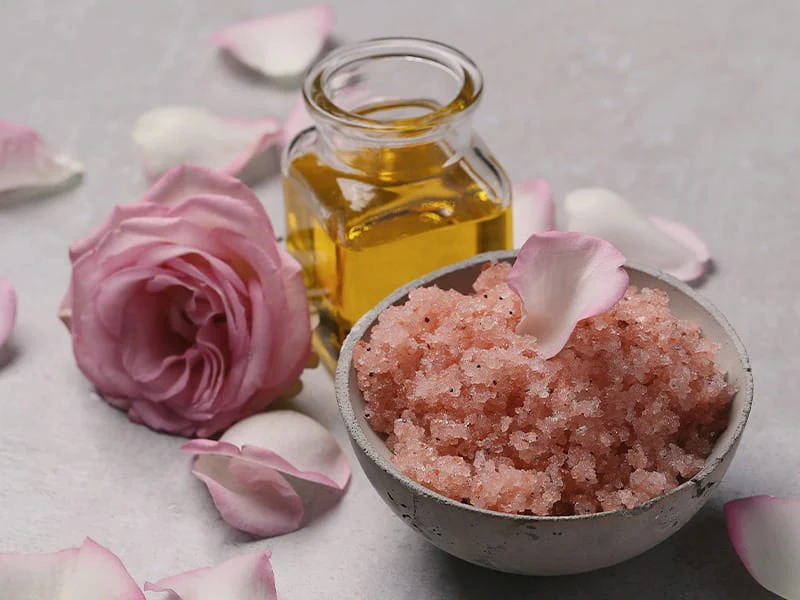
Here is how to use it on your face, step by step:
- Cleanse your face at night and pat it dry.
- Warm 2-3 drops of ready-to-use (or well-diluted) oil between your fingertips.
- Press gently onto cheeks, forehead and chin. Keep away from the eyes.
- Start 2-3 nights a week. If your skin is happy, you can use it every evening.
Fine lines: oils moisturise and can make skin look smoother for a while. No oil removes wrinkles. Daily sunscreen protects skin the most.
Dark spots or marks: it does not lighten skin or remove marks. A dermatologist can tell you what actually helps.
Rose oil for body and massage
- Body oil: a few drops of a ready-to-use blend on arms, neck and chest after a shower.
- Massage: mix a few drops with sweet almond oil for a lightly scented, relaxing massage.
- Personal scent: one drop on the wrists and behind the ears.
- Hands: a drop worked into the hands and cuticles at night.
| Use | How much (ready-to-use blend) | When |
|---|---|---|
| Face | 2-3 drops | Evening |
| Body | 4-6 drops | After a shower |
| Scent | 1 drop per spot | Any time |
| Massage | A few drops in a carrier oil | Evening |
| Blend | Mix rose with | Result |
|---|---|---|
| Fuller rose, lower cost | geranium oil | Rosy and fresh |
| Floral citrus | neroli oil | Light, elegant |
| Warm | frankincense oil | Rich, oriental |
| Fresh | bergamot oil (evening only, sun-sensitive) | Floral citrus |
Rose oil for diffuser
- Use a pure rose essential oil in a diffuser, not a ready-to-use oil. Most diffuser makers say not to put carrier oils in the water tank.
- Pure rose is expensive, so many people use one or two drops, or mix it with geranium for a fuller rose scent.
- Follow your diffuser’s instructions. Run it for 30-60 minutes, then turn it off, and keep the room ventilated.
- Keep diffusers away from babies and pets.
No diffuser? A drop of a ready-to-use blend on a cotton ball near you works too.
Why is rose essential oil so expensive?
Is rose essential oil expensive? Yes, and for a good reason. Rose petals hold very little oil, so a huge amount of hand-picked petals is needed to make a small bottle of real rose essential oil. That is why rose essential oil is expensive, and why it is one of the most copied oils.
So why can you find “rose oil” for very little at an attar shop and for many times more from a specialist? They are usually not the same product:
- Very cheap: usually a carrier oil with rose fragrance, or a perfume oil.
- Middle price: often a ready-to-use blend: a small amount of real rose essential oil in a carrier oil.
- High price: pure rose otto or rose absolute.
A high price alone is not proof of purity, and a low price is not always a fake. Check what is inside the bottle.
How much is rose essential oil in Egypt?
There is no single price, because “rose oil” means different products. Before you look at any price, check:
- Pure, ready to use or scented: the label should say which.
- Size: the price only means something next to the number of ml.
- Latin name: Rosa damascena.
- Essential oil or fragrance oil: “fragrance oil” or “perfume oil” means added scent.
You can see the type, size and current price of Amaly rose oil on its product page.
Rose oil side effects
- Skin irritation or allergy: it contains natural scent compounds that some people are allergic to. Patch test and stop if you see redness, itching or a rash.
- Never neat: pure rose essential oil must be diluted before it touches skin.
- Pregnancy and breastfeeding: ask your doctor before using any essential oil.
- Children: keep the bottle out of reach. Do not use on young children without a doctor’s advice.
- Eyes: keep away. If oil gets in your eye, rinse with plenty of clean water and see a doctor if it still stings.
- Never swallow essential oils. Rose water for cooking is a different product.
- Regular medicines or a chronic condition: ask your doctor or pharmacist before using essential oils often.
For external use only. Not a substitute for medical advice.
Tips for every reader
- Just curious: it is made from rose petals and is mainly used as a scent and skin oil.
- First time with oils: start with a ready-to-use blend, patch test, and use it in the evening.
- Sensitive skin or perfume allergy: patch test twice and try it on the body before the face.
- Pregnant or breastfeeding: ask your doctor first. A plain carrier oil with no essential oil is the safer choice until then.
- Parents: keep bottles out of children’s reach and do not use it on babies.
- Brides and gift buyers: rose oil is a classic gift. Pick a clearly labelled bottle in dark glass.
- Women 35+: it can be a pleasant part of a night routine. Pair it with daily sunscreen for the best care.
- On a budget: a ready-to-use blend or a rose and geranium mix gives the scent for less.
- Perfume lovers: rose blends well with geranium, neroli, frankincense and citrus.
- Spa and massage therapists: rose in a light carrier oil makes a special massage. Always ask clients about scent allergies.
Common myths
Myth: all rose oils are the same. Fact: rose otto, rose absolute, ready-to-use rose oil and rose-scented oil are four different products.
Myth: rose oil lightens or whitens skin. Fact: there is no good evidence that it lightens skin. It can leave skin looking fresh, and that is all it should promise.
Myth: rose oil and rosehip oil are the same. Fact: rose oil comes from the petals and is a scented oil. Rosehip oil (زيت ثمر الورد) is pressed from the seeds of the rose fruit and is a skin oil with very little scent.
Myth: if it is expensive, it is pure. Fact: price alone proves nothing. Check the label and ask for a lab test.
Myth: the paper or fridge test proves purity. Fact: home tests are not reliable. A lab test (GC-MS) is the real proof.
How to tell if rose oil is real
- Latin name on the label: Rosa damascena.
- Type: the label says pure essential oil, absolute or ready to use, and names the carrier oil if it is blended.
- Ingredient list: “fragrance” or “parfum” means added scent.
- Bottle: dark glass with a batch number and a date, not clear plastic.
- Smell: deep, slightly green and honey-like, not sharp or soapy.
- Cold: pure rose otto may turn cloudy or partly solid in the cold, then clear again when warm.
- Lab test: a seller who can share a GC-MS report for the batch is the best sign.
How to store rose oil so it lasts
Good storage protects the scent you paid for. Light, heat and air slowly change any essential oil, and an oil that has changed is more likely to irritate skin.
- Dark glass: keep it in the amber or dark bottle it came in. Clear plastic is not a good home for essential oils.
- Cool and dark: a drawer or cupboard away from the stove, the window and bathroom steam.
- Cap closed: close the bottle straight after use so air does not get in.
- Out of reach: keep every bottle away from children and pets.
- Check the date: use it before the date on the label. A ready-to-use blend contains a carrier oil, which can go off sooner. If the smell turns sour, sharp or flat, stop using it on skin.
Rose oil vs geranium oil
| Rose | Geranium | |
|---|---|---|
| Plant | Damask rose petals | Rose geranium leaves |
| Scent | Deep, rich rose | Rosy, fresh, green |
| Price | High | Moderate |
| Best for | Special evenings, gifts, perfume | Daily skin and massage routine |
What people say
We read what people share in essential oil communities about it. Here is what comes up most:
- Otto or absolute: people are split. Some say absolute smells closer to a fresh garden rose; others prefer otto for the classic rose scent. Others point out that quality and origin change the smell too (Reddit discussion).
- Lighter vs richer: a common way people describe them is otto as lighter and absolute as richer (Reddit discussion).
- Try before you buy: people suggest trying small amounts of both, because you can’t know which one you like until you smell them (Reddit discussion).
- How people wear it: diluted on the wrists or neck, or a couple of drops on a handkerchief to smell without putting it on skin. People also advise testing a small spot and waiting a day first (Reddit discussion).
- Diluted can smell nicer: some find rose smells better diluted than straight from the bottle (Reddit discussion).
- For a diffuser: rose is expensive to use up in a diffuser, so some people choose rose geranium for a rosy room scent instead (Reddit discussion).
- Very cheap rose: people warn that very cheap bottles from unknown sellers often have added synthetics (Reddit discussion).
Summary of public discussions, written by the Amaly team. Everyone’s experience is different.
Frequently asked questions
What does rose oil do for the face?
It leaves skin feeling soft and looking fresh, and gives a lovely scent. It is not a treatment for spots, marks or wrinkles.
Can I use it on my face every day?
Many people use it every evening. If your skin is oily or sensitive, start with 2-3 times a week.
How do I know if rose oil is real?
Look for Rosa damascena on the label, an honest ingredient list, a dark glass bottle and, best of all, a lab test for the batch.
Why is real rose essential oil so expensive?
Because a huge amount of petals makes only a small amount of oil.
Is rose oil the same as rosehip oil?
No. Rose oil comes from the petals; rosehip oil is pressed from the seeds of the rose fruit.
Can I wear it as a perfume?
Yes. A drop on the wrists gives a soft, natural rose scent.
Does rose oil lighten skin?
No. There is no good evidence that it lightens skin. See a dermatologist for dark spots.
How should I store it?
Cap closed, in a cool, dark place, away from children.
Try Amaly rose oil
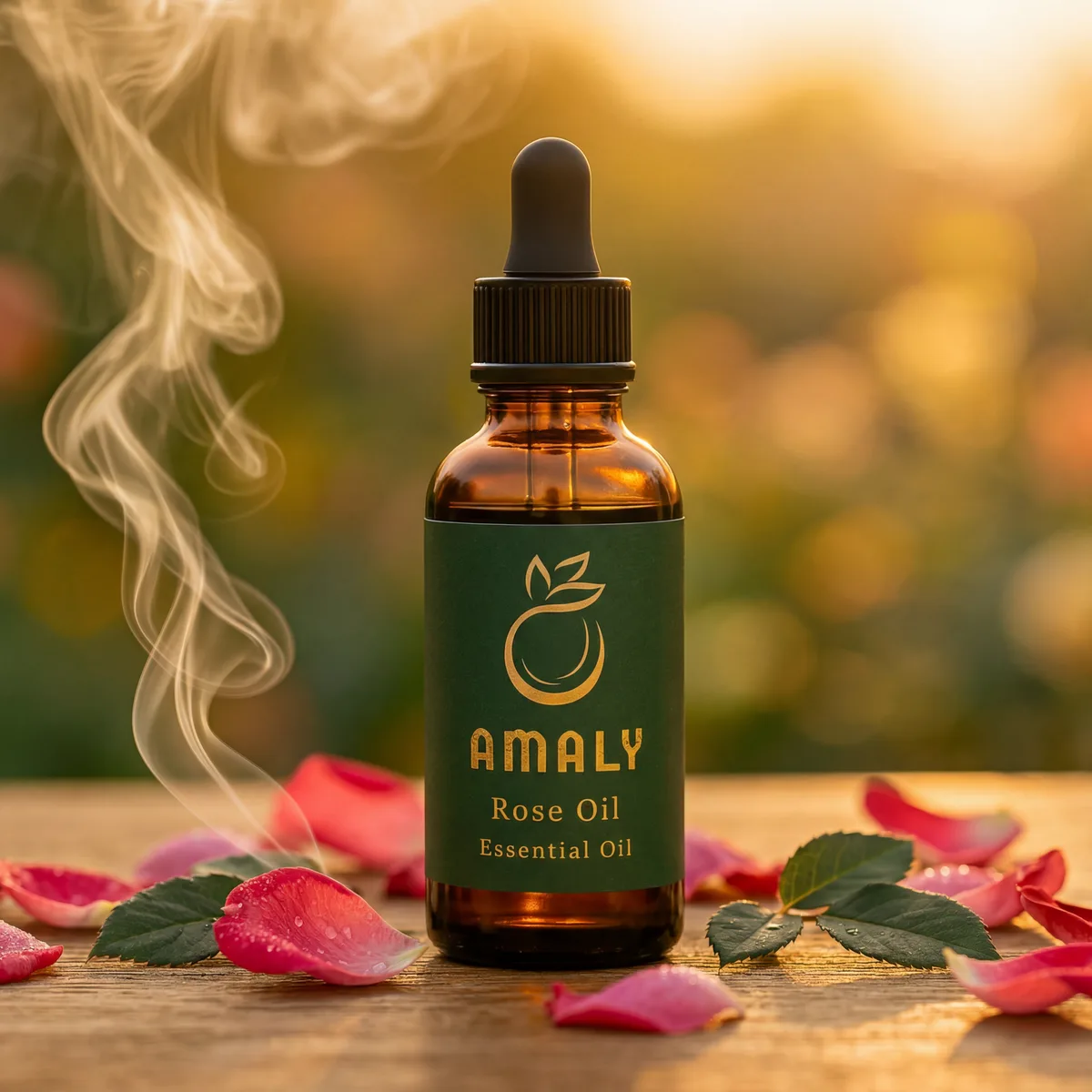
Amaly rose oil brings you the classic rose scent for your evening routine, with clear use instructions on the product page. It makes a lovely gift and is delivered across Egypt with cash on delivery.
Read next: geranium oil guide, frankincense oil guide, lemon oil guide and bergamot oil guide.
Sources
- The effects of Rosa damascena aromatherapy on mood and sleep: a systematic review and meta-analysis (PMC)
- Aromatherapy: what you need to know (NCCIH)
- Essential oil dilution chart (Tisserand Institute, based on Tisserand & Young, Essential Oil Safety, 2nd ed.)
- Essential oils – health warning (Government of Western Australia, Department of Health)

