
Key takeaways
- Frankincense oil has a warm, rich, woody-citrus scent and thousands of years of history, including in ancient Egypt.
- Today it is used mainly for scent, quiet evening moments, massage blends and perfume.
- Research on boswellia is mostly about supplements and lab studies, not the essential oil on skin.
- Pure frankincense essential oil must be diluted before it touches skin. It works well in a diffuser.
- Frankincense resin (اللبان الذكر), frankincense oil and “frankincense creams” are three different products.
Frankincense oil is used mainly for its warm, rich scent: in quiet evening moments, perfume and relaxing massage blends. It has a long and beautiful history, and also a lot of exaggerated claims online. This guide covers what frankincense oil is, its real benefits, how to use it on your face and skin, in a diffuser and in massage, its side effects, how to spot a real one, and what it costs in Egypt.
What is frankincense oil?
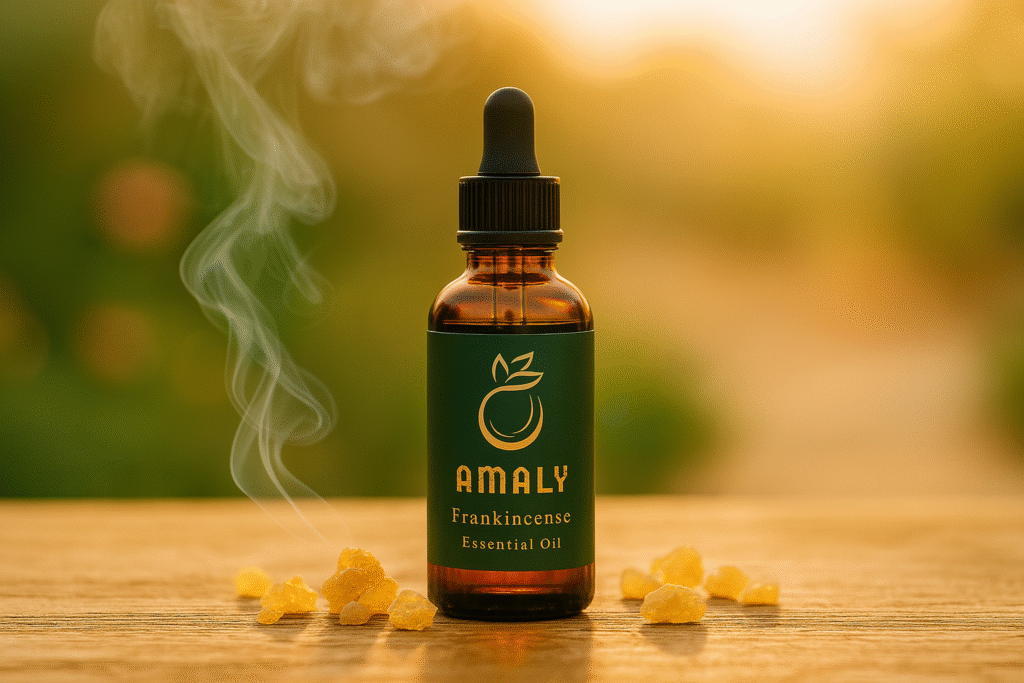
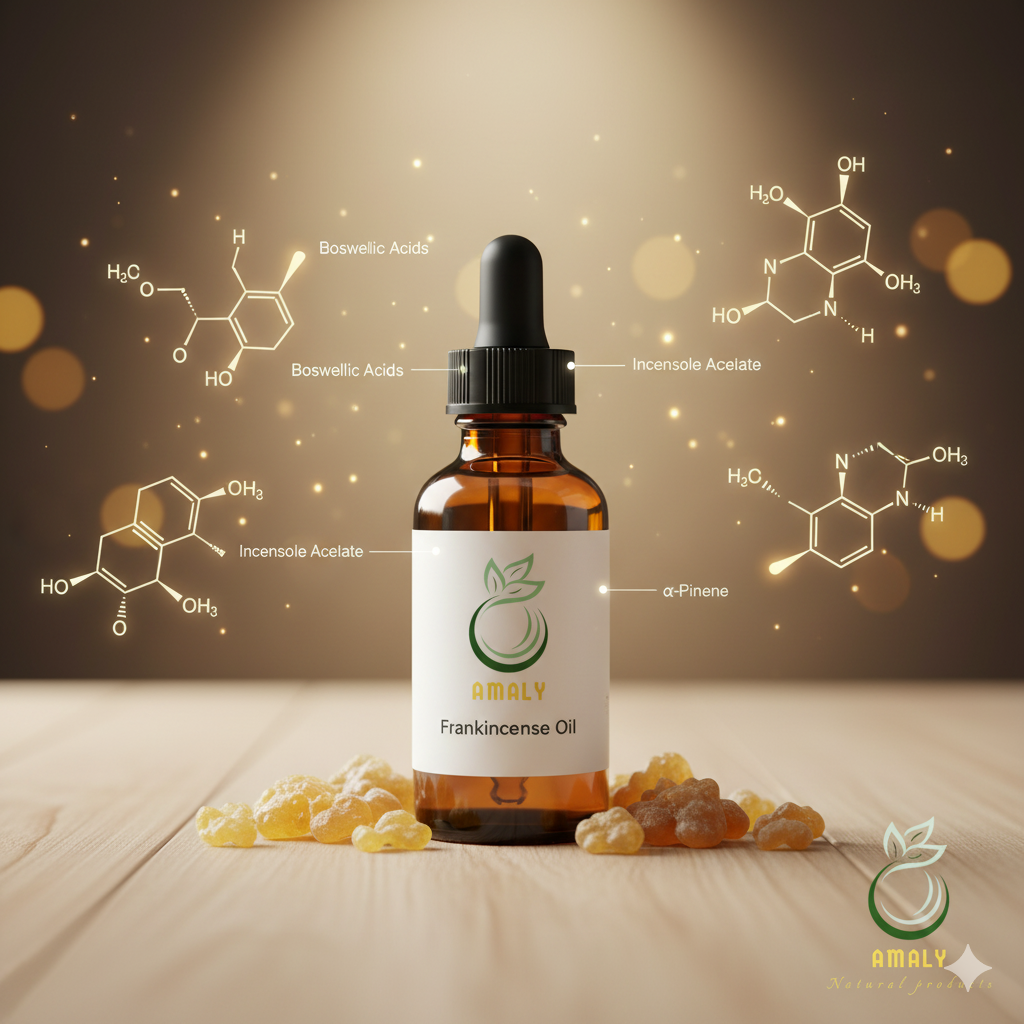
Frankincense (اللبان) is a resin from Boswellia trees that grow in Oman, Yemen, Somalia and the Horn of Africa. The trees “bleed” a sap that dries into tears of resin. Steam-distilling this resin gives frankincense essential oil.
- Resin: the dried sap of the tree. In Egypt the best-known kind is called اللبان الذكر (also spelled “laban dakar”).
- Olibanum: another name for frankincense resin.
- Boswellia sacra, carterii, serrata: different species. The oil from each smells a little different.
A short history
Ancient Egyptians burned frankincense in temples and used it in perfumes and rituals. It was traded across Arabia for centuries and is still burned as incense in homes across the region. Its scent is linked with calm and ceremony in many cultures, which is why it is still a favourite in Ramadan and on special occasions.
What does frankincense oil smell like?
Warm, woody and resin-like, with a fresh, slightly lemony top. It is softer and cleaner than burning resin, with no smoke.
Frankincense oil benefits: what it really does
These are the frankincense essential oil benefits that are honest to promise:
- A warm, rich scent: a calm, elegant smell for your home or skin.
- A calm evening routine: many people like its scent in quiet time before bed or during meditation.
- A relaxing massage: diluted in a carrier oil, it gives a warm scent to a back or shoulder massage.
- Perfume: a classic base note in oriental perfumes.
- Skin that feels soft: in an evening routine, the carrier oil leaves skin feeling soft and the frankincense adds scent.
What does research say? Most research is on boswellia extracts and supplements, or done in the lab on cells. Lab results do not show that a product works in people. The US National Center for Complementary and Integrative Health (NCCIH) page on boswellia explains that research in people is limited and more studies are needed. If you have a health condition, or pain that does not go away, see a doctor.
Frankincense resin vs oil vs cream
| Product | What it is | How it is used | Sold by |
|---|---|---|---|
| Resin (اللبان الذكر) | Dried tree sap, in “tears” | Burned on charcoal, traditional uses | Weight (grams or kilo) at attar shops |
| Essential oil | Steam-distilled resin, very concentrated | Diluted on skin, diffuser, massage | Small bottles (ml) |
| “Frankincense” creams | A cosmetic cream that contains some frankincense | As the label says | Tubes and jars |
| Incense sticks | Often mixed with other materials | Home scent | Packs |
So if you see “the price of a kilo of frankincense”, that is the resin, not the oil. Oil is sold by the ml and costs much more per gram because it takes a lot of resin to make a little oil.
If you burn resin or incense at home, keep the room ventilated and keep smoke away from babies and anyone who finds smoke hard to breathe.
How to use frankincense oil (step by step)
- Dilute: mix 1 drop of pure frankincense essential oil with about 1 teaspoon (5 ml) of carrier oil such as sweet almond or sesame oil. That is about 1%. For the body you can go up to 2 drops in 5 ml (about 2%).
- Patch test: put the blend on the inside of your arm and wait 24 hours.
- Use it: on the body, the face (below), in massage or as a scent.
- Check the oil: frankincense oil that smells sharp or “off” has oxidised. Do not use it on skin.
Frankincense oil for face
- Use a well-diluted blend (1 drop in 5 ml carrier oil) or a ready-to-use oil.
- Cleanse at night, then press 2-3 drops of the blend onto cheeks, forehead and chin.
- Keep away from the eyes and lips.
- Start every other night and see how your skin feels.
When will I see results on my face?
Frankincense oil is a scented cosmetic oil, not a treatment, so there is no “result date” to promise. Skin usually feels softer straight after use because of the carrier oil. If you are trying to fix dark spots, marks or any skin problem, see a dermatologist, who can tell you what will actually help.
Frankincense oil for skin
Using frankincense essential oil for skin is simple if you keep it diluted:
- Body oil: 1-2 drops of pure oil in 5 ml carrier oil, massaged onto damp skin after a shower.
- Dry areas: elbows, hands and heels in the evening.
- Never neat: pure frankincense essential oil should not go straight on skin.
- Broken or irritated skin: do not use it there.
Frankincense oil for diffuser
- A pure frankincense essential oil works well in a diffuser. Do not use a ready-to-use (carrier-oil) blend: most diffuser makers say not to put carrier oils in the water tank.
- Follow your diffuser’s instructions for the number of drops. A few drops are enough for a room.
- Run it for 30-60 minutes, then turn it off. Keep the room ventilated.
- Keep diffusers away from babies and pets.
- For a calm evening: frankincense with lavender or bergamot in the diffuser for half an hour before bed.
If you often have trouble sleeping or feel stressed most days, please talk to a doctor. A calm scent can be part of a routine, but it is not a treatment.
A relaxing frankincense massage at home
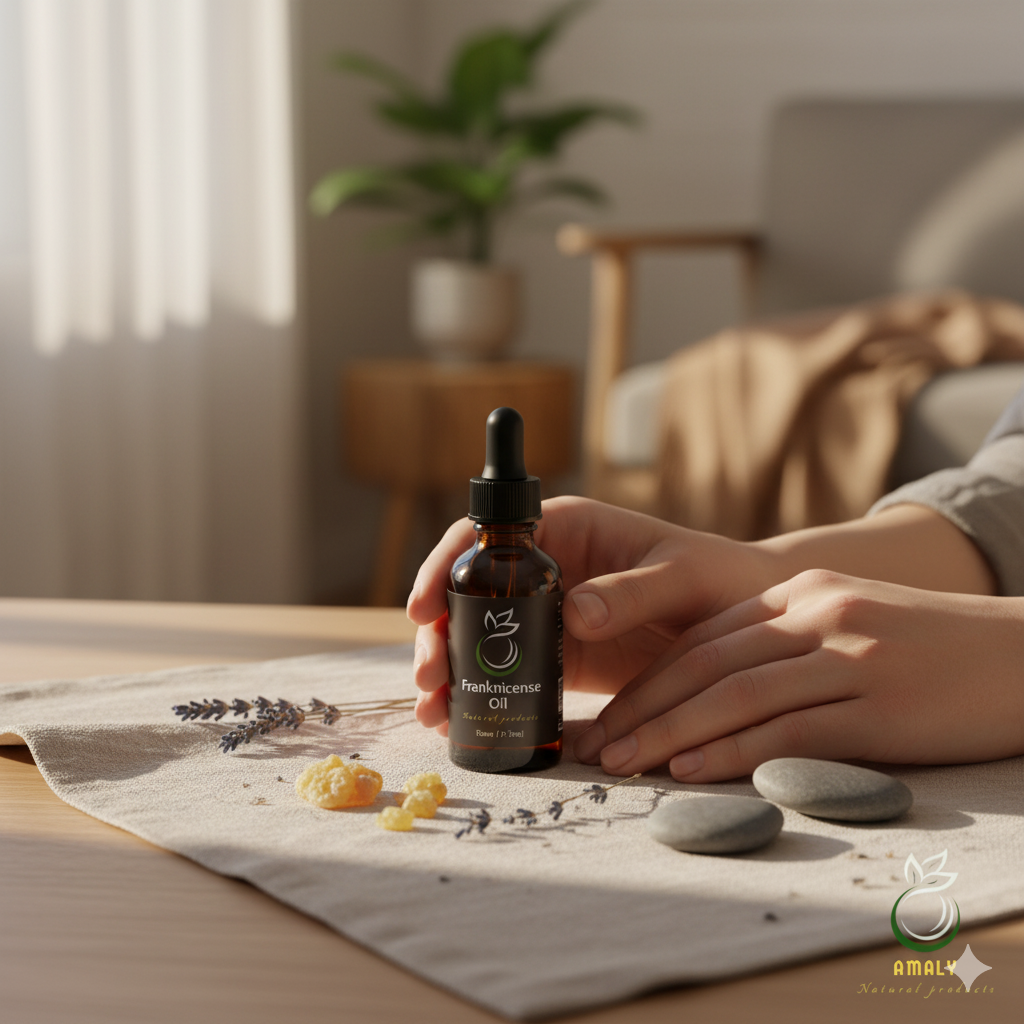
- Mix 30 ml of sweet almond oil with up to 6 drops of pure essential oil in total (about 1%): all frankincense, or 4 frankincense and 2 lavender.
- Patch test the blend 24 hours before.
- Warm the oil in your palms and massage shoulders, neck and back in slow circles for 15-20 minutes.
- Avoid the face, eyes and broken skin.
In winter, sesame oil makes a warmer base.
| Use | How |
|---|---|
| Face | 1 drop pure oil in 5 ml carrier oil |
| Body / massage | Up to 2 drops pure oil in 5 ml carrier oil |
| Diffuser | Pure oil only, a few drops, 30-60 minutes |
| Quiet time | 1 drop on a tissue nearby |
| Swallowing | Never |
Frankincense oil side effects
- Skin irritation: mostly from using it neat or using old, oxidised oil. Always dilute and patch test.
- Allergy: stop if you see redness, itching or a rash.
- Pregnancy and breastfeeding: ask your doctor first.
- Children: keep out of reach. Do not use on young children without a doctor’s advice.
- Regular medicines: ask your pharmacist before regular use of any boswellia product.
- Never swallow essential oils. Chewing resin and swallowing oil are not the same thing. If someone swallows the oil, call a doctor or poison centre.
- Keep away from the eyes.
For external use only. Not a substitute for medical advice.
Frankincense oil for every reader
- Just curious: frankincense is the same اللبان burned in homes for centuries. Its oil is mainly a scent and massage oil.
- First time with oils: start with a diluted blend on the body, not the face, and patch test.
- Looking for a calm evening: use it in a diffuser or on a tissue in quiet time. See a doctor if sleep or stress is a regular problem.
- Massage at home: follow the recipe above with sweet almond or sesame oil.
- Sensitive skin: patch test twice and stay at 1%.
- Pregnant or breastfeeding: ask your doctor first.
- Parents: keep bottles and burning resin away from children.
- Older adults: light massage only, and ask your doctor first if you have a chronic condition or take regular medicines.
- Perfume lovers: frankincense pairs well with rose, geranium and citrus.
- Buying a gift: frankincense is a classic for Ramadan and Eid.
- Checking value: look at the species name, whether it is pure or diluted, and the size in ml (see below).
Common myths about frankincense oil
Myth: frankincense oil is a medicine. Fact: it is a scented oil for massage and quiet moments. For any health condition, follow your doctor’s advice.
Myth: “therapeutic grade” means better. Fact: “therapeutic grade” is a marketing term, not an official standard. Look for the Latin name and a lab test instead.
Myth: a frankincense cream works the same as the oil. Fact: they are different products. Follow each product’s own label.
Myth: chewing resin is the same as using the oil. Fact: never swallow essential oil.
How to spot a real frankincense oil
- Latin name with species: Boswellia sacra, carterii or serrata.
- Country of origin on the label.
- Pure or diluted: the label should say which, and name the carrier oil.
- How it was made: steam-distilled from resin.
- Bottle: dark glass, batch number and date.
- Smell: fresh, woody and slightly lemony. A heavy, sweet “incense perfume” smell is often a fragrance oil, not essential oil.
- Lab test: a GC-MS test from the seller is a good sign.
Frankincense oil price in Egypt: what you are paying for
Frankincense essential oil is one of the more expensive oils, because a lot of resin makes only a little oil. Prices in Egypt vary a lot, so before you look at any price, check:
- Pure or diluted: pure essential oil costs more per ml but must be diluted. A diluted oil is cheaper per bottle.
- Size: the price only means something next to the number of ml.
- Species and origin: which Boswellia, and which country.
- Oil or resin: resin is sold by weight and oil by the ml, so their prices can’t be compared.
- Essential oil or fragrance oil: a very cheap “frankincense oil” is often a perfume oil.
Check frankincense oil availability and price on Amaly.
Frequently asked questions
What is frankincense oil?
An essential oil steam-distilled from the resin of Boswellia trees, with a warm, woody-citrus scent.
What are the benefits of frankincense oil?
A warm, rich scent for calm evenings, perfume and relaxing massage. It is not a medicine.
What is frankincense called in Arabic?
اللبان، and the well-known resin is often called اللبان الذكر.
How do I use frankincense oil on my face?
1 drop of pure oil in 5 ml carrier oil, at night, after a patch test, away from the eyes.
Can I use frankincense oil in a diffuser?
Yes, a pure frankincense essential oil. Not a ready-to-use carrier-oil blend.
Is frankincense oil good for massage?
Yes, diluted in a carrier oil it gives a warm, relaxing scent to a massage.
Where can I buy frankincense oil in Egypt?
Check frankincense oil availability on Amaly, and look for the species name and origin on any label.
Warm oils from Amaly
Check frankincense oil availability on Amaly. For a warm, relaxing massage, you can also try Amaly sesame oil, a warming massage oil for winter, or Amaly sweet almond oil, a light oil that is ideal for massage. Both are delivered across Egypt with cash on delivery.
Read next: lavender oil guide, tea tree oil guide and geranium oil guide.
Sources
- Essential oil dilution chart (Tisserand Institute, based on Tisserand & Young, Essential Oil Safety, 2nd ed.)
- Boswellia (NCCIH, US National Institutes of Health)
- Aromatherapy: what you need to know (NCCIH)
- Essential oils – health warning (Government of Western Australia, Department of Health)
Written by the Amaly team, with sources. Last updated: 11 November 2026.