
Key takeaways
- There are two main chamomile oils: Roman (soft, apple-like scent) and German (deep blue, herbal).
- This oil is used for its soft, calming scent, in gentle massage and in evening routines.
- Most chamomile research is about the tea and extracts, not the essential oil on skin.
- People allergic to plants in the daisy family (ragweed, daisies, marigolds) can react to chamomile.
- On the face, use 1% or less (1 drop in 5 ml of carrier oil) after a patch test.
In this guide
Chamomile oil is used mainly for its soft, calming scent and in gentle routines for skin, face and hair. Chamomile is one of the best-known herbs in the world, and Egypt is one of its big growers. This guide explains the two types of chamomile essential oil, its real benefits and uses, what research covers, how to use it, side effects, and how to tell a real one.
What is chamomile oil?
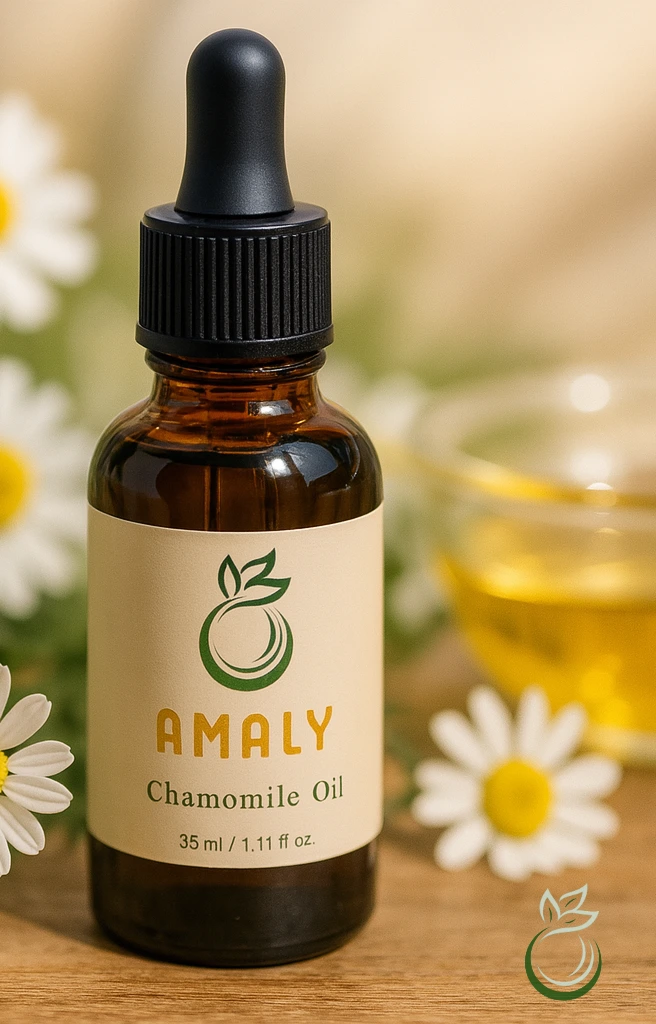
Chamomile essential oil is steam-distilled from chamomile flowers. Two kinds are sold, and they are different oils:
| Roman chamomile | German chamomile | |
|---|---|---|
| Latin name | Chamaemelum nobile (also Anthemis nobilis) | Matricaria chamomilla (also M. recutita) |
| Colour | Pale yellow, almost clear | Deep blue (from chamazulene, formed during distillation) |
| Scent | Soft, sweet, apple-like | Strong, herbal, a little earthy |
| Best for | Scent, evening blends, massage | Gentle skin blends |
The blue colour of German chamomile is natural. It can fade to green or brown as the oil ages. A good label always says which chamomile is in the bottle.
Chamomile oil benefits: what it really does
These are the benefits that are honest to promise:
- A soft, calming scent: Roman chamomile is a favourite for evenings.
- Gentle massage: diluted in a carrier oil, it suits a slow, relaxing massage.
- Evening routine: a calm scent as part of winding down before bed.
- Gentle skin blends: a small amount in a body or face oil, after a patch test.
- Blending: it mixes well with lavender, bergamot, rose and geranium.
Uses of chamomile oil
- A few drops (pure oil) in a diffuser in the evening.
- A diluted evening massage oil for shoulders, back or feet.
- One drop of pure oil in a carrier oil for a warm evening bath.
- A drop in a body oil or a face oil (see the face section below).
- A drop in a hair oil for scent.
What does research say about chamomile?
The US National Center for Complementary and Integrative Health (NCCIH) summarises the research. Most of it looks at chamomile tea, capsules and extracts, not the essential oil on skin. Key points:
- There is very little research on chamomile and sleep. A 2019 review found only one sleep study, and it showed no benefit.
- Results for tea and capsules do not tell you what the essential oil does on skin.
- Chamomile can cause allergic reactions, especially in people allergic to the daisy family.
- A calm scent can be part of a good bedtime routine. If you often struggle to sleep, please see a doctor.
Roman or German chamomile oil: which one to choose
Both are real chamomile oils, but they suit different jobs. Pick by what you want to use it for.
| You want | Better choice | Why |
|---|---|---|
| A soft scent for evenings or a diffuser | Roman | Sweet, apple-like smell that most people find gentle |
| A calm massage blend | Roman | Mixes easily with lavender, bergamot and rose |
| A small amount in a body or face oil | German | Herbal and strong, so a little goes a long way |
| Light-coloured fabrics or towels nearby | Roman | German’s deep blue colour can mark cloth |
If the label only says “chamomile oil” with no Latin name, you cannot tell which one you have. Ask the seller before you buy.
Daisy-family allergy: a quick check before using chamomile oil
Chamomile belongs to the daisy family (Asteraceae). If you have ever reacted to any of these plants, skip chamomile oil or ask your doctor first:
- Ragweed, daisies or chrysanthemums
- Marigold (calendula) creams or oils
- Echinacea or arnica products
- Chamomile tea, if it ever made your mouth or skin itch
Even without a known allergy, do the 24-hour patch test on the inside of your arm. Stop at once if you see redness, itching or swelling, and see a doctor if the reaction does not settle.
How to use chamomile oil (step by step)
- Check allergies: if you are allergic to ragweed, daisies, marigolds or chrysanthemums, skip it.
- Patch test: a small amount, diluted, on the inside of your arm. Wait 24 hours.
- Dilute: pure oil must be diluted. Body: 2% (about 2 drops in 5 ml of carrier oil). Face: 1% or less (1 drop in 5 ml).
- Massage: warm the oil in your hands and massage slowly.
- Blend: mix with sweet almond oil for a light, gentle base.
Chamomile oil for skin
- A drop in a body oil after a shower is a gentle way to enjoy it.
- Skip broken, sore or irritated skin.
- This oil is a scented oil, not a skin treatment. If a rash, redness or itching does not go away, see a dermatologist.
Chamomile oil for face
- Use 1% or less (1 drop in 5 ml of a light carrier oil), after a patch test.
- Keep it away from the eyes.
- Stop if your skin turns red, itchy or tight.
- Chamomile does not react with the sun like bergamot or cold-pressed lemon, but it can still irritate sensitive skin.
Chamomile oil for hair
Chamomile is added to hair oils mainly for its scent. Add 1 drop to a spoon of carrier oil for a scalp massage, or 1-2 drops to one wash of shampoo. There is no good evidence that the oil lightens hair colour; that idea comes from rinsing with chamomile tea.
| Blend idea | Mix with | Mood |
|---|---|---|
| Evening calm | Roman chamomile + lavender | Soft, sleepy |
| Calm citrus | Chamomile + bergamot | Fresh, relaxed |
| Floral | Chamomile + rose | Gentle, rosy |
| Warm | Chamomile + frankincense | Quiet, cosy |
Chamomile oil massage for a calm evening
Roman chamomile is one of the gentlest scents for a slow evening massage. The massage itself helps you slow down, and the oil adds a soft, sweet scent.
- Mix: about 2 drops of pure chamomile oil in 5 ml of sweet almond oil (about 2%) for the body.
- Hands first: rub the mix between your palms and take a few slow breaths.
- Shoulders and upper back: long, slow strokes from the neck outwards.
- Hands and feet: small circles on the palms and soles, then gentle strokes along each finger and toe.
- Finish: wrap up warm and rest for a few minutes.
Skip broken or irritated skin. For ongoing pain or a recent injury, see a doctor or physiotherapist first.
A warm chamomile bath or foot soak
Essential oils do not mix with water on their own, so always blend them first.
- Bath: mix 1-2 drops of chamomile oil into a tablespoon of carrier oil, then add it to warm bath water and swirl.
- Foot soak: mix 1 drop into a teaspoon of carrier oil, add it to a bowl of warm water, and soak your feet for 10 minutes.
- Take care getting out: oil can make the bath slippery.
Chamomile oil for diffuser
A diffuser is the easiest way to enjoy chamomile, because the oil does not touch your skin. Roman chamomile is the usual choice.
- Use a pure essential oil, not a blend in a carrier oil. Carrier oils can damage the diffuser.
- About 3-5 drops for every 100 ml of water is a common start; follow your diffuser’s instructions.
- Run it for 30-60 minutes in a ventilated room, then turn it off.
- Keep diffusers away from babies and pets, and stop if anyone in the room has a daisy-family allergy.
- If someone at home has a sensitive chest or dislikes strong smells, use fewer drops or shorter sessions, and stop if they start coughing or feel uncomfortable.
| Moment | Blend | Feel |
|---|---|---|
| Wind-down | 2 drops Roman chamomile + 2 drops lavender | Soft and calm |
| Early evening | 2 drops chamomile + 1 drop bergamot | Fresh and relaxed |
| Guests at home | 2 drops chamomile + 1 drop rose | Gentle floral |
| Quiet reading | 2 drops chamomile + 1 drop frankincense | Warm and cosy |
A calm evening routine with chamomile oil
Research on chamomile and sleep is limited (see above), so think of the oil as a pleasant part of a routine, not a sleep aid.
- One hour before bed: 30 minutes of chamomile in the diffuser, then switch it off.
- After a warm shower: a short hand or foot massage with the diluted oil.
- Lights low, phone away: let the scent be the signal that the day is over.
- Same time every night: a steady routine is what makes evenings feel calmer.
If you often struggle to sleep or feel stressed most days, please talk to a doctor.
Chamomile oil side effects
- Allergy: people allergic to ragweed or the daisy family can react to chamomile. Patch test first.
- Skin irritation: stop if you see redness, itching or a rash.
- Pregnancy and breastfeeding: ask your doctor first.
- Children: keep out of reach. Do not use on children without a doctor’s advice.
- Eyes: keep away. If it gets in your eye, rinse with plenty of clean water and see a doctor if it still stings.
- Never swallow essential oils.
- Regular medicines or a chronic condition: ask your doctor or pharmacist before using chamomile often.
For external use only. Not a substitute for medical advice.
Common mistakes with chamomile oil
- Skipping the patch test because chamomile “is gentle”.
- Using it with a known ragweed or daisy allergy.
- Drinking the oil or adding it to tea. Chamomile tea and chamomile oil are very different.
- Putting German chamomile on light clothes or towels: the blue colour can stain.
- Using more than 1% on the face.
- Putting a carrier-oil blend in a diffuser.
How to store chamomile oil
Keep the cap tightly closed and the bottle upright in a cool, dark cupboard, away from heat, sunlight and children. German chamomile slowly turns from blue to green or brown as it ages; a strong colour change or a sharp smell means the oil is past its best, and old oil is more likely to irritate skin.
Chamomile tea or chamomile essential oil?
In Egypt most people know chamomile as a tea, so the two are easy to mix up. They are used very differently.
| Chamomile tea | Chamomile essential oil | |
|---|---|---|
| What it is | Dried flowers steeped in hot water | A concentrated oil distilled from the flowers |
| How it is used | Drunk as a warm drink | Smelled in a diffuser, or diluted on skin |
| Swallowing | Yes, it is a food drink | Never |
| Research | Most chamomile studies look at tea and extracts | Very little research on the oil itself |
The daisy-family allergy applies to both. If chamomile tea has ever made you itch, avoid the oil too.
Chamomile oil vs lavender oil
| Chamomile (Roman) | Lavender | |
|---|---|---|
| Scent | Soft, sweet, apple-like | Fresh, floral, herbal |
| Best moment | Evening wind-down, gentle massage | Evening routine, massage, linen spray |
| Allergy to watch | Daisy family (ragweed, marigold) | Less common, still patch test |
| Price | Usually pricier (many flowers per bottle) | Usually more affordable |
They also work well together: a drop of each in a diffuser is one of the most popular calm blends.
Tips for every reader
- Just curious: this oil is distilled from the flowers. Roman smells like soft apple, German is blue and herbal.
- First time with oils: start with Roman chamomile in a diffuser in the evening.
- Sensitive skin: patch test, keep it at 1% on the face, and stop if irritated.
- Allergic to daisies or ragweed: skip chamomile.
- Trouble sleeping: a calm scent can help you wind down. If it happens often, see a doctor.
- Scent lovers: chamomile adds a soft, sweet note to lavender or bergamot.
- Pregnant or breastfeeding: ask your doctor first.
- Parents: keep bottles out of children’s reach.
- Massage at home: chamomile with sweet almond oil makes a gentle evening massage.
- Checking value: check which chamomile, pure or ready to use, and size (see below).
Common myths
Myth: chamomile oil is the same as chamomile tea. Fact: the essential oil is far more concentrated. Never drink it.
Myth: blue chamomile has gone bad or is dyed. Fact: German chamomile is naturally blue.
Myth: chamomile is so gentle that nobody reacts to it. Fact: people allergic to the daisy family can.
How to tell if chamomile oil is real
- Latin name: Chamaemelum nobile (Roman) or Matricaria chamomilla (German).
- Colour: German should be blue (or blue-green if older). Roman is pale.
- Pure or ready to use: the label should say which, and name the carrier oil if blended.
- Bottle: dark glass with a batch number and a date.
- Lab test: a GC-MS report from the seller is the best sign.
Chamomile oil price in Egypt: what you are paying for
Pure oil, especially Roman, takes a lot of flowers to make, so it is one of the pricier oils. Before you look at any price, check:
- Which chamomile: Roman and German are different oils with different prices.
- Pure or ready to use.
- Size: the price only means something next to the number of ml.
- Essential oil or fragrance oil: very cheap “chamomile oil” is often a scented oil or flowers soaked in oil.
Check chamomile oil availability and price on Amaly.
Frequently asked questions
What is chamomile oil used for?
Mainly for its soft, calming scent: in a diffuser in the evening, in a gentle massage blend, in a warm bath, or as a drop in a body or hair oil. It is a scented oil, not a treatment, so for any skin or health problem, please see a doctor or pharmacist.
What is the difference between Roman and German chamomile?
Roman chamomile (Chamaemelum nobile) is pale with a soft, sweet, apple-like scent and suits evenings, diffusers and massage. German chamomile (Matricaria chamomilla) is deep blue and more herbal, and is usually used in small amounts in skin blends. A good label always names which one is inside.
Can I use chamomile oil on my face?
Yes, at 1% or less (about 1 drop in 5 ml of a light carrier oil) after a 24-hour patch test on the inside of your arm. Keep it away from the eyes, and stop if your skin turns red, itchy or tight. Skip it completely if you are allergic to the daisy family.
Is chamomile oil good for hair?
It is mainly added to hair care for its scent. One drop in a spoon of carrier oil for a scalp massage, or 1-2 drops in one wash of shampoo, is enough. There is no good evidence that it lightens hair colour. For hair fall or dandruff that does not settle, see a dermatologist.
Why is my chamomile oil blue?
German chamomile turns blue naturally during steam distillation, when a compound called chamazulene forms. The colour is a good sign that it is German chamomile. It can fade to green or brown as the oil ages. Roman chamomile is pale yellow, almost clear, so a blue colour is not expected there.
Who should avoid chamomile oil?
Anyone allergic to ragweed or the daisy family, such as daisies, marigold or chrysanthemums, should avoid it. Pregnant or breastfeeding women should ask a doctor first, and it should not be used on children without a doctor’s advice. If you take regular medicines, ask your pharmacist before using it often.
Can I use chamomile oil in a diffuser?
Yes, a diffuser is one of the easiest ways to enjoy it. Use pure Roman chamomile, about 3-5 drops for every 100 ml of water, and run it for 30-60 minutes in a ventilated room. Keep it away from babies and pets, and from anyone with a daisy-family allergy.
Can I use chamomile oil before sleep?
Yes, as part of a wind-down routine: a short diffuser session or a diluted hand and foot massage before bed. Research on chamomile and sleep is limited, so enjoy it for the calm scent rather than as a sleep aid. If you often struggle to sleep, talk to a doctor.
How should I store chamomile oil?
Keep the cap tightly closed and store the bottle in a cool, dark place, away from heat, sunlight and children. German chamomile slowly changes from blue to green or brown as it ages. If the colour changes a lot or the smell turns sharp, the oil is past its best.
Can I mix chamomile oil with lavender?
Yes, it is one of the most popular calm pairs. In a diffuser, try 2 drops of Roman chamomile with 2 drops of lavender in 100 ml of water. For a massage, add both to a carrier oil such as sweet almond, keeping the total at about 2% for the body.
Try a calm evening routine
Check chamomile oil availability on Amaly. For a calm evening massage you can also use Amaly sweet almond oil as a light base, or Amaly bergamot oil for a calm citrus scent. Both are delivered across Egypt with cash on delivery.
Read next: lavender oil guide, bergamot oil guide, geranium oil guide and frankincense oil guide.

